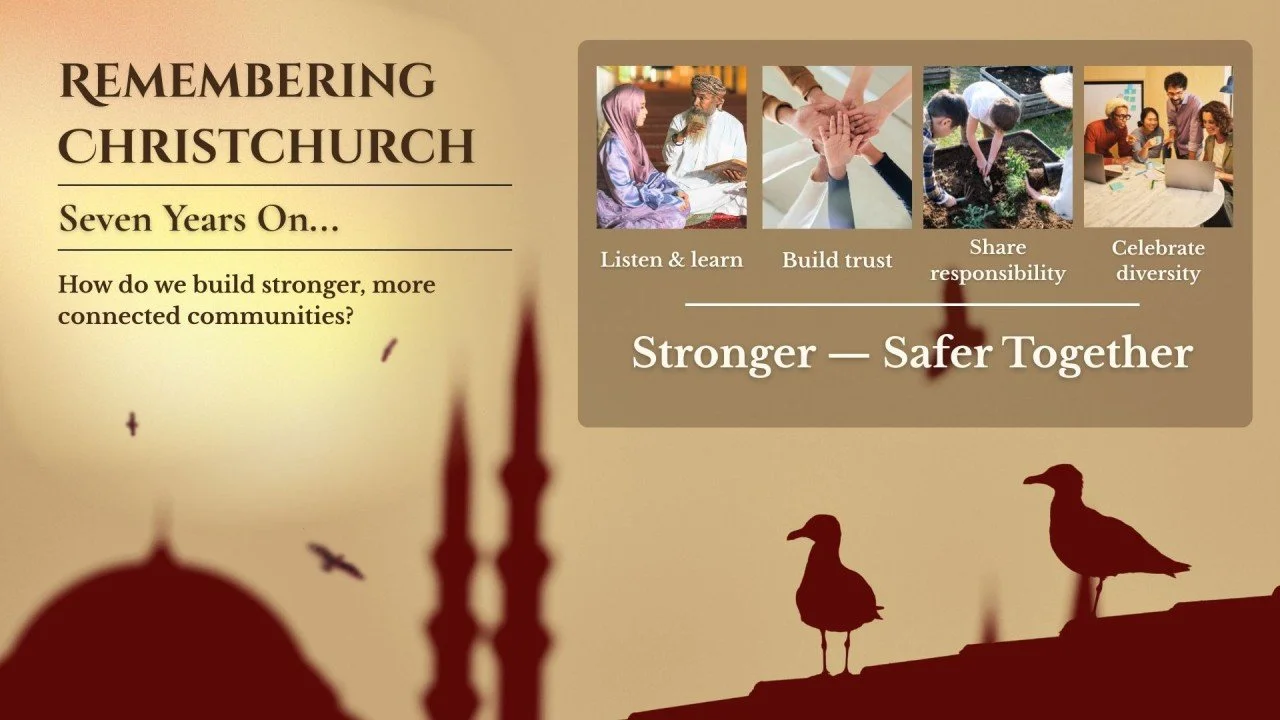
What the Christchurch Inquiry Teaches Us About Stronger Communities
Each year the anniversary of the Christchurch mosque attacks reminds us of a profound tragedy in New Zealand’s history.
It also reminds us of the work required to build a society where everyone feels safe, valued and connected.
In December 2020, the Report of the Royal Commission of Inquiry into the terrorist attack on Christchurch masjidain highlighted a consistent message from communities across New Zealand:
“Communities we spoke with wanted to see greater social cohesion and told us about their wish for closer community connections to help all people feel safe and welcome.”
The report noted that social cohesion has important benefits. When communities are connected, people are more likely to lead happy, rewarding and participatory lives, contributing to stronger societies.
Importantly, strong social cohesion also reduces the risk of people becoming radicalised towards extremist or violent behaviours.
One of the report’s recommendations (Recommendation 37) was to create opportunities for regular public conversations that help New Zealanders improve their understanding of:
• social cohesion and social inclusion
• the collective effort required to achieve it
• the value that ethnic and religious diversity contributes to society
These insights are important not only for national policy, but also for local communities.
Social cohesion ultimately grows through relationships between people in the places where they live.
In Wellington’s northern suburbs of Newlands, Paparangi and Woodridge, we are currently exploring a community resilience initiative through the Aotearoa Community Resilience Network (ACoRN).
The goal is simple but important: to strengthen the relationships, trust and shared understanding that help communities thrive in both everyday life and times of disruption.
The approach focuses on several practical elements:
• encouraging neighbour-to-neighbour connection
• creating regular community conversations
• supporting local mentors and community connector
• strengthening community voice and participation
• building understanding across cultures, faiths and generations
These are not large national programmes. They are human-scale community practices that strengthen the social fabric of a neighbourhood.
When people know their neighbours, when communities talk openly, and when diverse voices are respected, something powerful happens.
Belonging grows. Trust deepens. And fear has less space to take root.
The Christchurch tragedy reminds us that social cohesion cannot simply be assumed. It must be actively stewarded by communities, institutions and leaders together.
Across New Zealand many people are doing this work quietly every day — in schools, faith communities, neighbourhood groups, councils and voluntary organisations.
The work underway in Newlands is one small contribution to that wider effort.
Remembering Christchurch is about looking back and asking how we build communities where people feel connected, respected and responsible for one another.
Because ultimately, the strength of a society is measured not just by its institutions, but by the quality of the relationships between its people.
#SocialCohesion #Christchurch #CommunityResilience #ACoRN #StrongerCommunities