The Royal Commission of Inquiry into COVID-19 Lessons Learned has now published two major reports examining New Zealand’s experience of the COVID-19 pandemic.
Taken together, these reports highlight an important insight.
Many of the challenges exposed during the pandemic were not unique to pandemics. They reflected deeper social, economic and governance dynamics that tend to intensify during times of crisis.
These include:
• declining trust in institutions
• fragmented and contested information environments
• the difficulty of weighing complex trade-offs under uncertainty
• uneven levels of community resilience.
The two phases of the inquiry explore different but complementary aspects of this challenge.
Phase One focuses primarily on communities, trust and social cohesion, while Phase Two examines decision systems, legislation, economic policy and institutional capability. Together they point toward a broader lesson: future resilience depends on strengthening both public decision systems and community capability.
The Community Dimension: Trust, Relationships and Local Capability
The Phase One report highlights the critical role of social cohesion and trusted relationships during crises. Communities that are connected, informed and organised are better able to respond when disruptions occur. This is particularly important in the early days of a crisis, when neighbourhoods often rely on their own networks before formal systems can respond. Strengthening neighbourhood relationships, preparedness and trusted information flows therefore becomes an essential part of national resilience. Community resilience cannot be created overnight. It grows through sustained investment in relationships, trust and local capability.
The Decision System Dimension: Public Value Under Uncertainty
The Phase Two report focuses on how governments make decisions during crises. It highlights the importance of strong strategic capability at the centre of government, supported by:
• high-quality data and modelling
• clear frameworks for weighing trade-offs
• robust legislative guardrail
• transparent economic policy responses.
Decision-makers during the pandemic often had to act under significant uncertainty. The lesson is not that difficult decisions can always be perfect, but that decision systems must be designed to support good judgement under uncertainty. This includes ensuring Ministers receive advice that clearly articulates trade-offs, risks and long-term impacts, enabling decisions that maximise public value.
Connecting Decision Systems and Communities
One of the most important insights from the COVID-19 experience is that decision systems and community resilience are deeply interconnected. Strong public decision systems rely on:
• trusted institutions
• credible information
• constructive relationships between government and communities.
Likewise, communities are more likely to support difficult decisions when they understand the reasoning behind them and trust the institutions making them. Strengthening this relationship between policy systems and community capability therefore becomes a key task for future resilience.
Bridging Systems and Communities
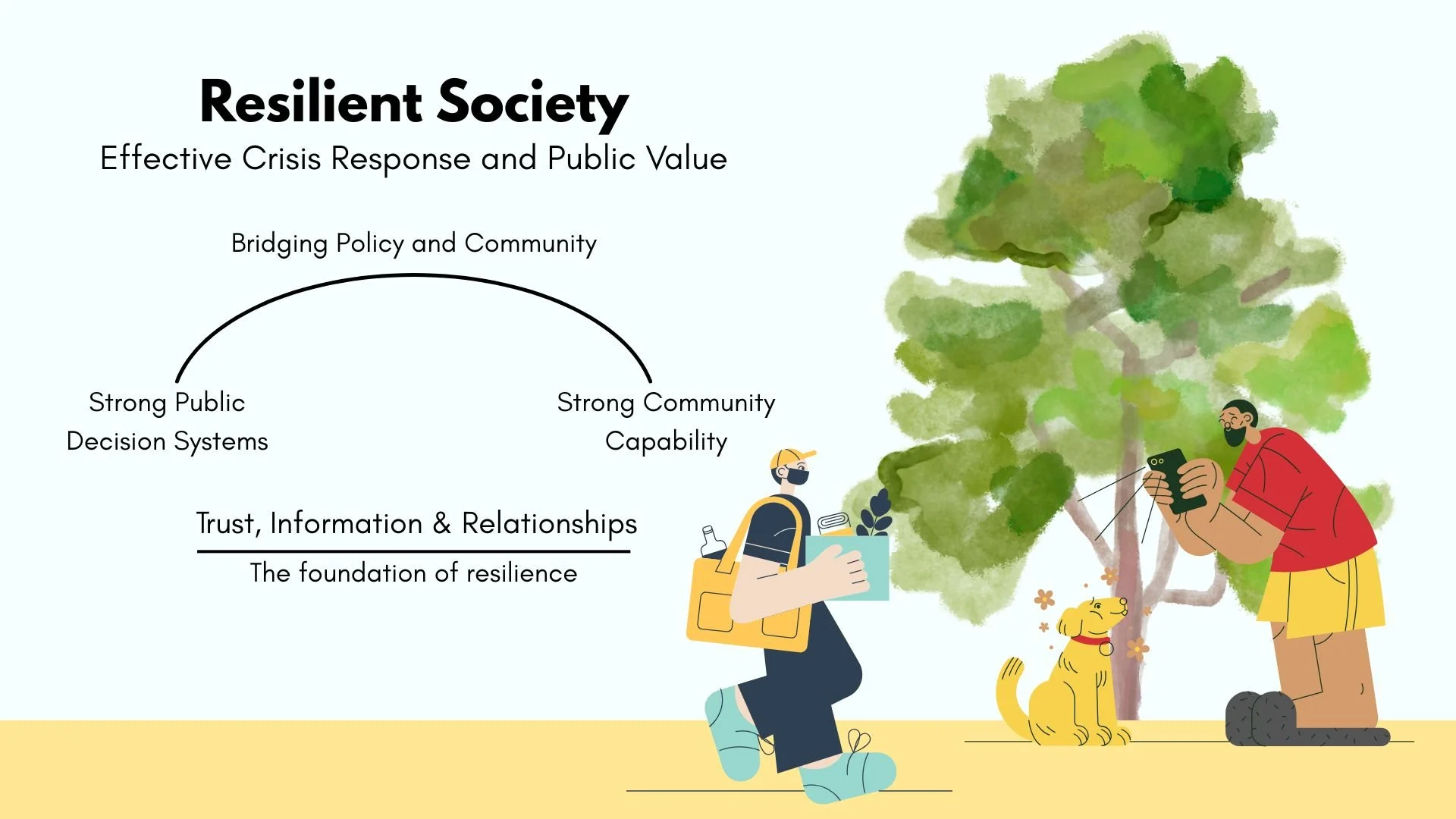
One practical implication of this insight is that strengthening resilience requires attention to both decision systems and community capability. Work on public-value decision frameworks such as Better Decisions → Better Outcomes (BDBO) focuses on improving how complex public decisions are made — ensuring evidence, trade-offs and long-term impacts are clearly understood. Initiatives such as the Aotearoa Community Resilience Network (ACoRN) operate at the complementary end of the system, strengthening the relationships, preparedness and local insight that help communities respond during crises. When these two dimensions reinforce one another, decision-makers are better informed, and communities are better able to act — increasing the likelihood that difficult decisions lead to outcomes that genuinely serve the public good.
A Shared Challenge for the Future
Taken together, the COVID-19 inquiry reports highlight the importance of:
• strong public decision systems
• clear legal frameworks
• resilient economic policy
• sustained attention to trust and social cohesion
• capable and connected communities.
Resilience is not created solely through institutions, nor solely through communities. It emerges when both work together. Future preparedness will therefore depend not only on better crisis planning, but on strengthening the connection between evidence, policy and community capability, so that when difficult decisions must be made, they are both well-informed and widely trusted. If the lessons of COVID-19 are to be fully realised, they must be embedded not only in national policy settings but also in the everyday capability of communities. Only then can societies respond to future crises with both effective institutions and resilient communities. BDBO strengthens how decisions are made, ACoRN strengthens how communities connect, and together they help societies achieve better outcomes.