
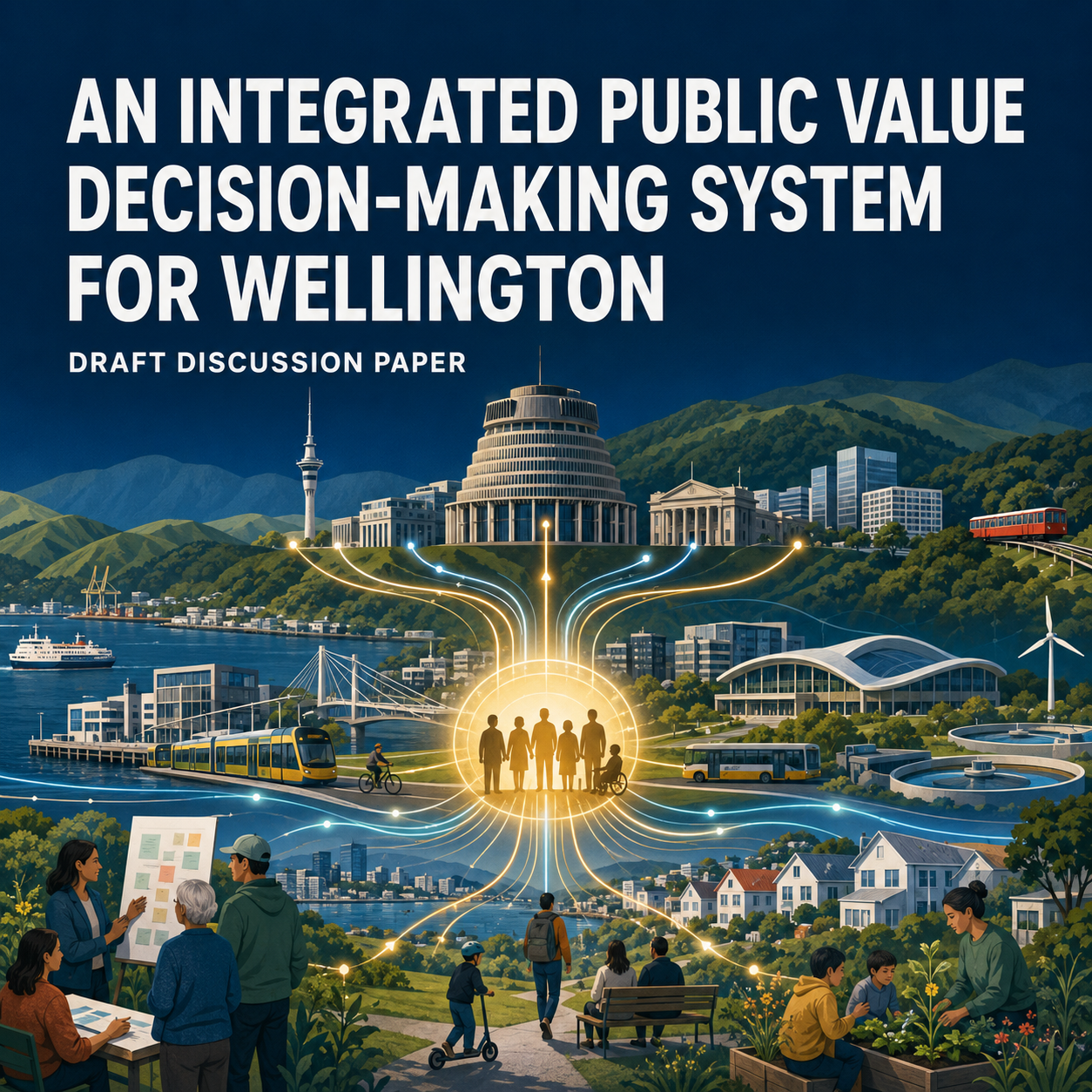
An Integrated Public Value Decision-Making System for Wellington
An independently authored draft discussion paper inviting feedback on a provisional assessment of Wellington’s public-investment decision-making system and possible capabilities for improvement.
Wellington has substantial plans, institutions, expertise and community capability. The challenge is that strategies, investment, services, engagement and reporting often operate through different processes, timeframes and accountabilities.
Infrastructure, housing, earthquake risk, climate adaptation, transport, public finances, social connection and economic vitality are interdependent. The proposed Rates Capping Bill increases the need to consider affordability, services, infrastructure renewal, debt, resilience and intergenerational effects together. These choices will affect communities differently, particularly those least able to absorb higher costs, reduced services or deferred investment.
A connected system
My draft discussion paper, An Integrated Public Value Decision-Making System for Wellington, explores how existing capabilities could be connected around shared outcomes.
Human flourishing means people and communities being safe, connected, healthy, resilient, economically secure and able to participate, with resources stewarded for future generations.
The proposal is not another framework or layer of governance. It would preserve democratic authority and statutory responsibilities, with mana whenua participation shaped through direct engagement. It would connect institutional stewardship, disciplined thinking, a city-wide investment portfolio, community intelligence, implementation and learning.
A draft, provisional diagnosis
The paper includes an author-led desktop adaptation of the IMF Public Investment Management Assessment framework. It examines whether Wellington’s institutional arrangements are translating into effective, connected city-wide decision-making and identifies issues that warrant further testing.
This is a draft assessment based primarily on published information. Its judgements are hypotheses—not findings about Wellington City Council, a completed assessment or an official IMF view. The assessment considers Wellington’s wider cross-government public-investment system and requires validation through local evidence, experience and stakeholder perspectives. Its purpose is to build on existing capability, not assign fault.
People with Wellington-specific knowledge may hold evidence that is not publicly available or identify important context I have missed. Their feedback is therefore necessary to correct factual errors, fill evidence gaps and test whether the provisional judgements are fair and reasonable.
Possible complementary capabilities
At city level, a place-based Portfolio Business Case could connect outcomes, strategic choices, affordability, investment priorities, dependencies, risks and measurable public value before detailed programme and project business cases are developed. Better Decisions, Better Outcomes (BDBO) is one possible method.
At neighbourhood level, communities provide continuing intelligence about local relationships, vulnerabilities, assets and change. The ACoRN Model and Newlands are one possible demonstration of stewarding community and disaster resilience while providing community intelligence to city and macro-level decisions.
These possible responses are propositions for testing, not predetermined conclusions. I developed BDBO, which I offer commercially through Rodney Barber Associates, and chair ACoRN, whose proposed contribution is pro bono and overseen by its Board. Any subsequent commissioning would be separate and transparent.
The paper draws on more than three decades of public-investment work and community resilience experience in Newlands. In the older Greek sense of politics as a community’s shared affairs, speaking up is civic participation—not party-political advocacy. The paper is my own work and was prepared without external commissioning or funding.
Feedback is needed
I am publishing this draft so its evidence, provisional PIMA judgements and proposed capabilities can be scrutinised and improved before any conclusions are treated as settled. I particularly welcome corrections, additional or contrary evidence and alternative interpretations.
Feedback is invited on three questions:
Is the evidence accurate and sufficiently complete?
Are the provisional PIMA judgements reasonable?
Do the proposed capabilities follow logically from the diagnosis?