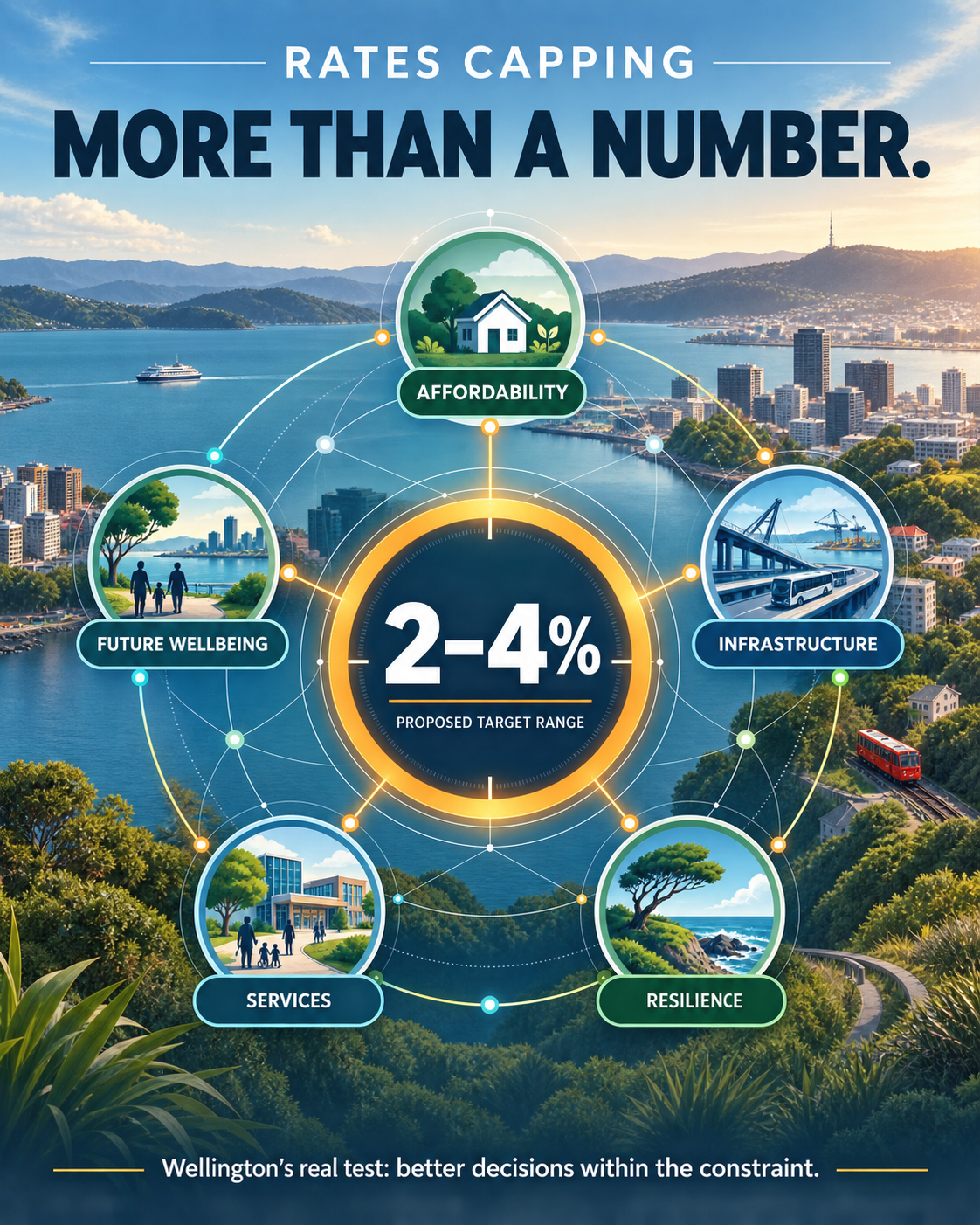
Rates Capping Is More Than a Number
Rates Capping Is More Than a Number: A Test of Wellington’s Public Decision-Making System
The Local Government (Rates Capping) Amendment Bill sharpens a longstanding public-management question: how can councils protect affordability while sustaining the infrastructure, services, resilience and community capability on which people depend? The Bill passed its first reading on 1 September 2026 and was referred to the Finance and Expenditure Committee.
It proposes an initial 2-4% target range for annual increases in councils' average non-water rates price. Councils would consider the range during 2027/28 and 2028/29 and comply from 2029/30 unless exempted. Individual bills could still vary, and drinking water, wastewater and stormwater charges are excluded.
For Wellington, meeting a percentage is only part of the challenge. Outcomes are shaped across central, regional and city government, mana whenua, infrastructure and service providers, businesses, community organisations and neighbourhoods. Rates capping may encourage discipline and clearer priorities, but a narrow response could shift costs into fees, debt, asset sales, reduced services or deferred maintenance, affecting households, neighbourhoods and generations differently.
The central public-value question is not simply, “How do councils comply?” It is:
How can Wellington’s wider public decision-making system make transparent choices within the constraint while protecting long-term value and human flourishing?
Human flourishing means enabling people, communities and the natural environment to thrive now and over time.
My independently authored draft discussion paper, An Integrated Public Value Decision-Making System For Wellington, suggests that Wellington does not primarily lack plans, institutions or capable people. The challenge is that decisions, investment, services, performance information and community participation are not sufficiently connected across national, regional, city and neighbourhood levels.
The proposed integrating system would connect shared outcomes and strategic choices; national policy with regional and local implementation; investment, services and infrastructure; accountability; performance information and learning; and continuing mana whenua and community knowledge. It would treat neighbourhood intelligence as part of Wellington's decision-making infrastructure, not merely occasional consultation.
The paper includes an author-led desktop adaptation of the IMF Public Investment Management Assessment framework. This draft assessment is based primarily on published information. Its judgements are hypotheses, not findings about Wellington City Council, a completed assessment or an official IMF view, and require Wellington-specific validation.
Rates capping provides an immediate test of whether information can travel in both directions: institutional evidence informing local choices, and neighbourhood experience, capability and outcomes informing government and institutional decisions.
At neighbourhood level, the ACoRN Model and Newlands offer one possible demonstration of stewarding community and disaster resilience while providing continuing community intelligence. Six years of local measurement, relationships and resilience activity provide a base for learning, while recognising that every community is different.
I am sharing this draft to invite critique and evidence, not promote a predetermined solution. It is my own work, draws on more than three decades of public-investment and community-resilience experience, and was prepared without external commissioning or funding. I particularly need feedback on three questions:
Is the evidence accurate and sufficiently complete?
Are the provisional PIMA judgements reasonable?
Do the proposed capabilities follow logically from the diagnosis?
Rates capping is more than a revenue constraint. It should prompt a deeper conversation about how Wellington makes connected choices. Better decisions require connected evidence, visible trade-offs, capable institutions, meaningful community intelligence and a willingness to learn.
Feedback closes on 30 September 2026. Please return feedback to rodney@barberassociates.org.