
What If Community Resilience Is Seen as an Investment Rather Than a Cost?
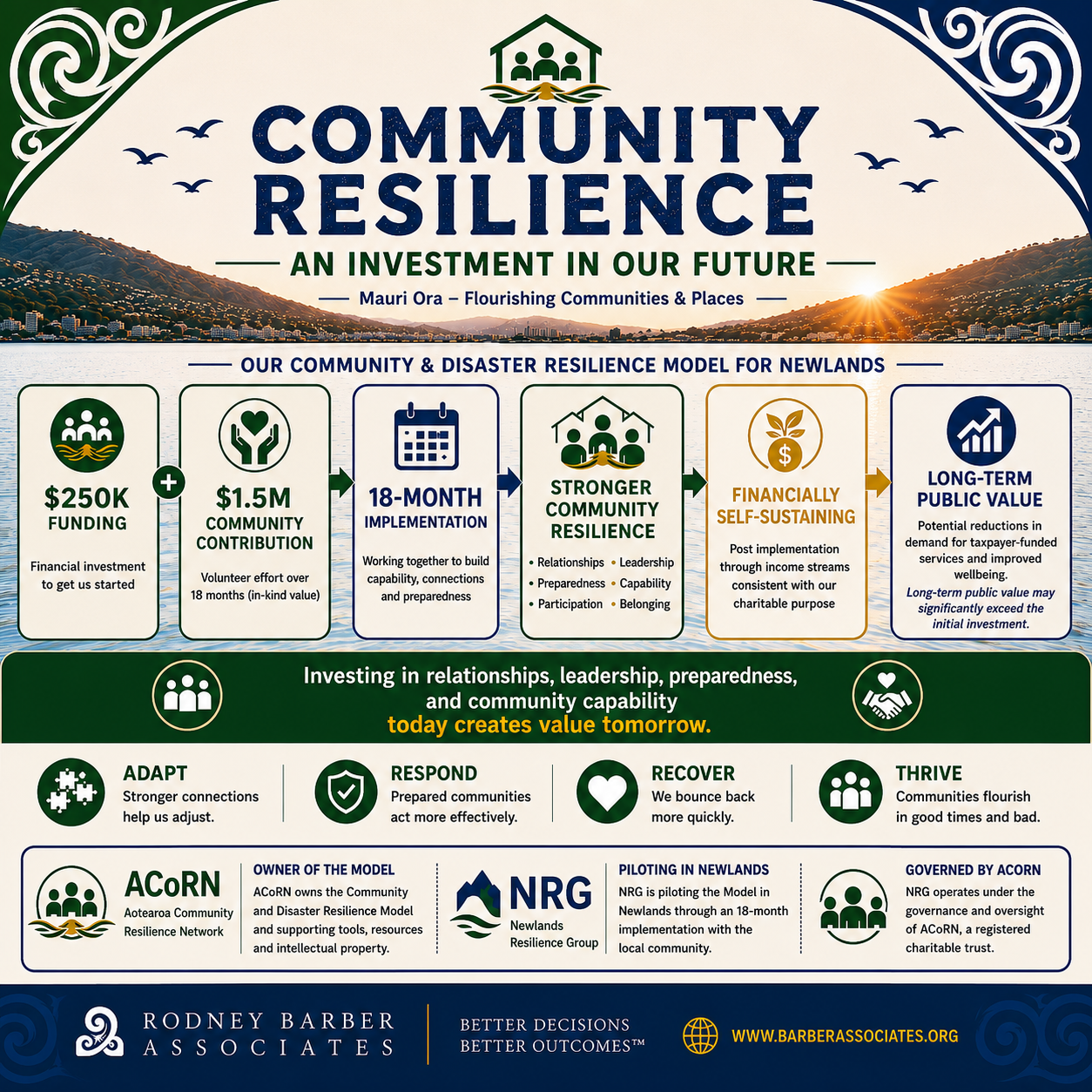
Every day, governments, councils, organisations, and communities invest in assets and services designed to improve future outcomes and reduce future risks. We invest in roads, water infrastructure, public facilities, technology, and public services because they create future value. They strengthen capability, improve wellbeing, reduce risk, and help communities function more effectively over time.
Yet one important form of investment is often overlooked: community resilience.
Resilience initiatives are frequently treated as discretionary spending rather than strategic investment. During periods of financial pressure, they can be among the first activities questioned, delayed, or reduced. This may reflect a misunderstanding of what community resilience actually is.
What Is Community Resilience?
Community resilience is the capacity of people, neighbourhoods, organisations, and communities to anticipate, adapt, respond to, and recover from challenges and disruptions while providing community intelligence to inform decisions that affect them.
Importantly, resilience is not something that suddenly appears during a crisis. It is built beforehand through relationships, trust, leadership, networks, preparedness, participation, and community capability. These are investments in future adaptive capacity.
Most organisations understand the value of preventative maintenance for physical assets. Community resilience can be viewed in much the same way. Investment today can help reduce future social, economic, and recovery costs while improving future outcomes.
The benefits extend well beyond disaster response. Community resilience contributes to social cohesion, wellbeing, participation, trust, collective problem-solving, local leadership, and stronger connections between people and institutions. It can also generate valuable community intelligence that helps inform better local and public-sector decision-making.
This raises an important public value question:
If resilience generates long-term benefits, reduces future risks, and supports better outcomes, should it be viewed primarily as a cost or as an investment?
A Pilot Happening in Newlands, Wellington
In Newlands, Wellington, we are currently seeking approximately $250,000 to support an 18-month implementation of a Community and Disaster Resilience Model developed through six years of local engagement, research, and learning.
Alongside this financial investment, we estimate the model could mobilise more than $1.5 million of volunteer effort during implementation.
The objective is not simply to improve emergency preparedness. It is to strengthen social connection, community capability, participation, leadership, wellbeing, and resilience across the suburb.
Based on our preliminary modelling, a more resilient and connected community may reduce future demand for a range of taxpayer-funded services, including mental health, social support, and community response services. If realised, the long-term public value generated could significantly exceed the initial investment required.
The model is also designed to become financially sustainable following implementation through income streams consistent with ACoRN's charitable purpose. We also intend to engage a university partner to help evaluate implementation and outcomes.
The question is not whether communities create value. They already do. The question is whether we are willing to invest intentionally in strengthening that value.
Beyond Newlands
Beyond Newlands, the model has the potential to be adopted by other suburbs and communities at relatively low cost. Future communities may be able to adopt proven tools, processes, training, and resources while avoiding much of the initial development cost.
As Wellington considers how best to invest in its future, community resilience deserves to be part of that conversation.
Not because it replaces infrastructure, public services, or public institutions.
But because it helps those investments achieve their intended outcomes.
Community resilience is not simply a cost to be managed.
It may be one of the most important long-term investments we can make in people, relationships, leadership, capability, wellbeing, and the future resilience of our communities.
Next week, I will explore a related question:
Who should invest in community resilience, and what role should communities, councils, businesses, government agencies, and funders play?