
Community Capability: Wellington's Most Important Hidden Asset
Much of the discussion about Wellington's future focuses on infrastructure, housing, transport, economic development, public services, and environmental sustainability.
These conversations are important. Strong infrastructure and effective public services are essential foundations of a thriving city.
Yet there is another form of capability that influences the success of almost every public investment, despite receiving far less attention.
That capability exists within communities themselves.
What is Community Capability?
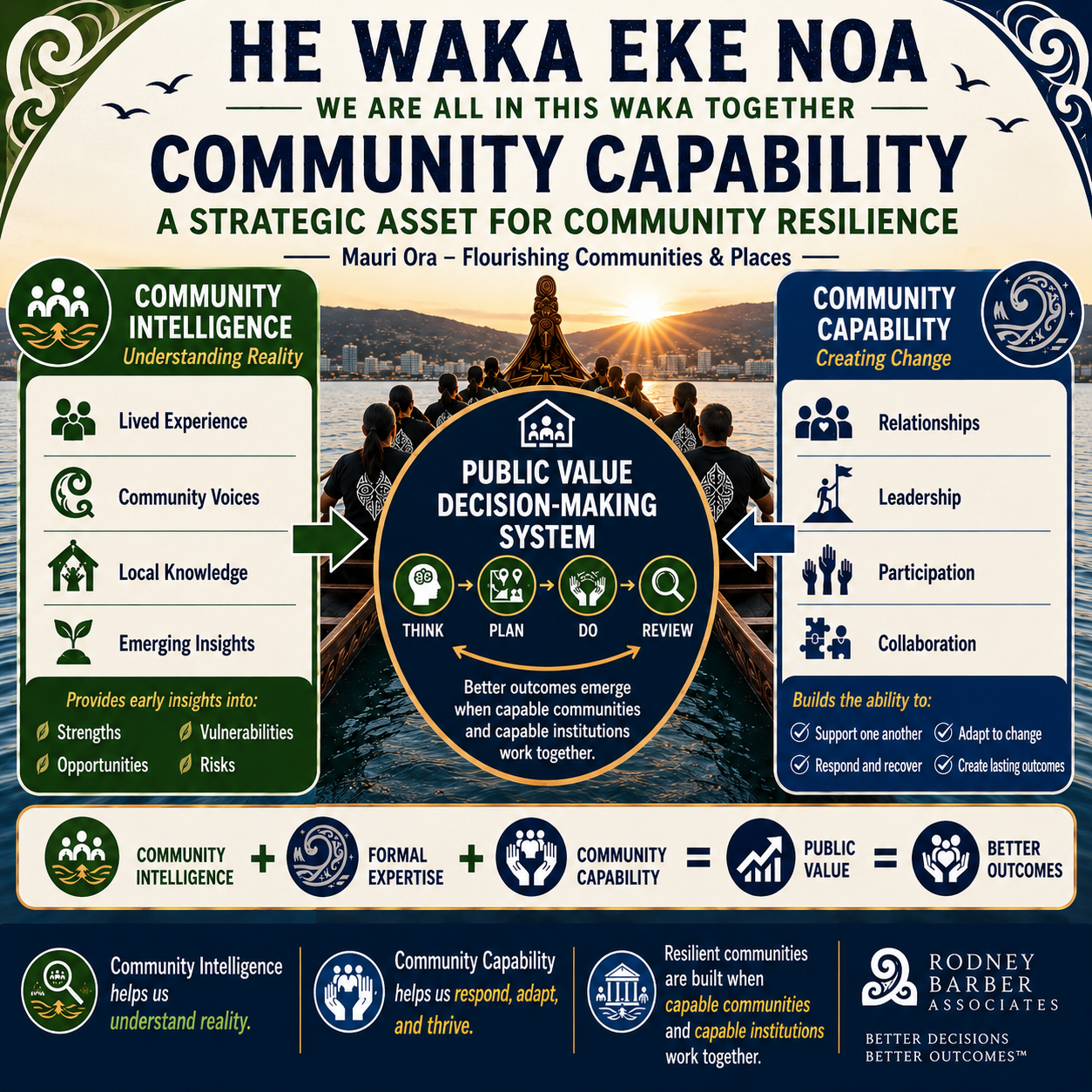
Community capability is the ability of people, neighbourhoods, organisations, businesses, schools, faith communities, marae, and local leaders to work together to identify challenges, support one another, solve problems, adapt to change, and create positive outcomes.
Unlike physical infrastructure, community capability cannot simply be purchased and installed.
It develops through relationships, trust, participation, leadership, learning, and shared experience.
Importantly, community capability is not the same as community intelligence.
Community intelligence helps us understand what is happening within a community. It provides insight into local strengths, vulnerabilities, needs, opportunities, and lived experiences.
Community capability is what enables communities to respond.
One helps us understand reality.
The other helps us act within it.
Both are important.
Why It Matters
Communities today are navigating economic uncertainty, natural hazards, demographic change, social fragmentation, and increasing pressure on public services.
Government agencies, councils, and service providers cannot address every challenge alone.
Nor should they.
Many of society's most important outcomes emerge through the combined efforts of families, neighbours, volunteers, community organisations, businesses, local institutions, and public agencies working together.
When community capability is strong, communities are often better able to:
Support vulnerable residents.
Respond during emergencies and disasters.
Build social connection and reduce isolation.
Mobilise volunteers and local leadership.
Identify emerging issues early.
Adapt to change.
Work constructively with public institutions.
Turn investment into lasting outcomes.
When community capability is weak, even well-designed policies and significant investments can struggle to achieve their intended results.
The Infrastructure We Rarely Measure
Councils manage roads, pipes, buildings, parks, and transport networks as strategic assets.
Asset condition is monitored. Risks are assessed. Investment plans are developed. Renewal programmes are funded.
Yet community capability is often treated as something that simply exists rather than something that can be intentionally developed, strengthened, measured, and sustained.
This raises an important question:
If we systematically manage physical infrastructure, why do we rarely take the same approach to community capability?
Community Capability as a Strategic Asset
What if community capability was viewed as an asset that contributes directly to public value?
What if we sought to understand:
Where capability is strong?
Where capability is vulnerable?
What factors strengthen or weaken it?
What investments could build capability over time?
How capability contributes to resilience, wellbeing, and long-term outcomes?
This does not mean transferring government responsibilities onto communities.
Rather, it means recognising that resilient communities are built through partnership.
Strong institutions matter.
Strong communities matter.
The greatest public value is often created when both work together.
Lessons from Community Resilience
This reality has become increasingly apparent through the work of the Newlands Resilience Group and the Aotearoa Community Resilience Network (ACoRN)-a charitable trust
While physical preparedness remains important, many of the factors that influence resilience are social.
· Relationships.
· Trust.
· Leadership.
· Participation.
· Neighbourhood connections.
· Community organisations.
· Volunteer networks.
These factors often determine how effectively communities respond to challenges, recover from disruption, and adapt to change.
They are not fixed.
They can be developed.
They can be supported.
And they can be strengthened through deliberate investment and stewardship.
A Wellington Opportunity
As Wellington considers its future, perhaps one of the most important questions is not simply what infrastructure we need to build.
It is what capability we need to grow.
The cities that thrive in the future are unlikely to be those with the most infrastructure alone.
They will be those that successfully combine capable institutions, capable communities, and informed decision-making.
Community intelligence helps us understand reality.
Community capability helps us act within it.
Together, they create the conditions for better decisions, better outcomes, and flourishing communities and places.
Because resilient cities are not built by infrastructure alone.
They are built by capable communities and capable institutions working together.