
What Communities Should Look for in a Budget
My Public Value Assessment Based on Experience in Government Decision-Making and Building Resilient Communities
Every year governments release Budgets outlining how a nation intends to invest in its future. Media coverage often focuses on tax changes, deficits, debt levels, or headline spending announcements. But many communities are asking a deeper question: “What does this Budget mean for the long-term future of our nation, communities, and future generations?”
After more than 30 years working in public sector investment, government decision-making, and more recently developing Better Decisions Better Outcomes within my Public Value Decision-Making System while helping build resilient communities, I increasingly view Budgets as national stewardship documents.
In my view, a Budget is far more than a financial statement. It is one of the clearest expressions of how a nation chooses to steward collective resources, strengthen resilience, build long-term capability, and pursue wellbeing for current and future generations.
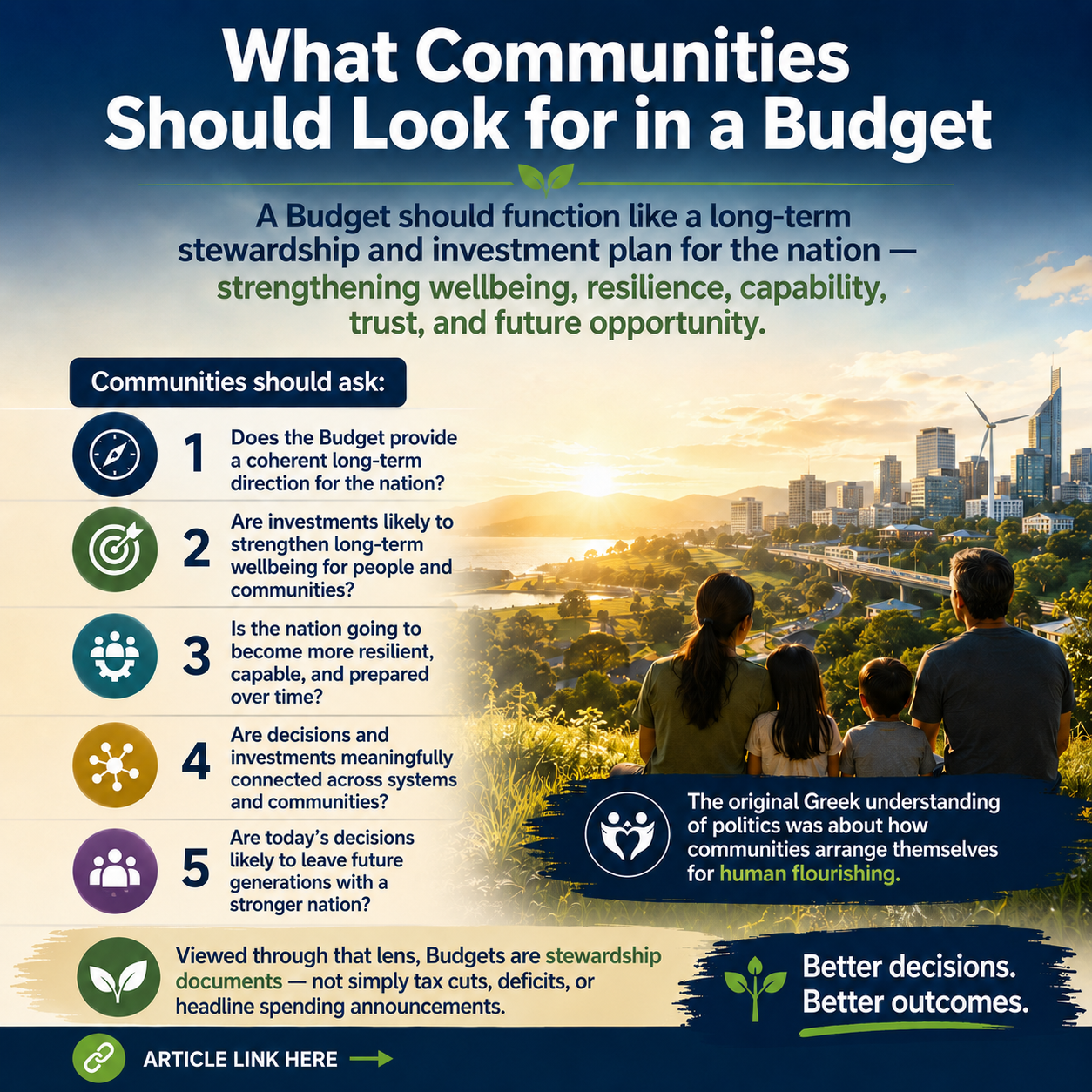
The original Greek understanding of politics is helpful here. Politics was not primarily understood as party competition or short-term electoral advantage. At its core, politics concerned how communities organise themselves for human flourishing.
Viewed through that lens, Budgets should not be assessed only through short-term fiscal or political narratives. They should also be assessed by whether they are likely to strengthen long-term public value, resilience, wellbeing, trust, and future opportunity.
From my perspective, communities can assess any Budget by asking five practical questions.
1. Does the Budget provide a coherent long-term direction for the nation?
My assessment: MAYBE
The Budget appears to provide clearer direction around economic growth, infrastructure investment, fiscal discipline, and national capability. However, it remains less clear how the various investments connect into one coherent long-term vision for the overall wellbeing and resilience of the nation.
Based on my experience in government investment and decision-making systems, strong stewardship requires governments to clearly explain the future being pursued, the outcomes being sought, how decisions connect across systemsand how progress will be measured over time. While parts of that story are visible, the overall long-term narrative still feels fragmented.
2. Are investments likely to strengthen long-term wellbeing for people and communities?
My assessment: MAYBE
There are important investments in health, education, infrastructure, and economic activity. These may improve wellbeing in several areas.
However, long-term wellbeing also depends on factors such as mental wellbeing, community connection, trust in institutions, social cohesion, resilience at local level and whether all communities have meaningful opportunities to benefit over time
Through both my public sector work and community resilience initiatives, I have increasingly come to see that resilient communities require more than service delivery alone. They also require connection, trust, capability, participation, and long-term locally grounded investment.
In my view, the Budget contains elements that may contribute positively, but it remains less clear whether the overall pattern of investment is sufficiently integrated and sustained to strengthen long-term wellbeing across all places and communities.
3. Is the nation becoming more resilient, capable, and prepared over time?
My assessment: MAYBE
There are stronger signals around infrastructure, fiscal sustainability, energy security, and national capability.
But resilience is broader than infrastructure and fiscal settings alone.
Based on my experience working both within government systems and alongside communities, resilient nations also depend on capable institutions, connected communities, trusted leadership, adaptable systems, strong local relationships and communities that are prepared before crises occur
Many of the pressures facing modern societies are interconnected and long-term: climate risks, infrastructure resilience, ageing populations, workforce capability, fiscal sustainability, social cohesion, and disaster preparedness.
While some important foundations are being strengthened, the broader relationship between national resilience, community resilience, and long-term stewardship still appears underdeveloped.
4. Are decisions and investments meaningfully connected across systems and communities?
My assessment: NO
In my experience, this remains one of the clearest weaknesses within many modern public systems.
People experience life as connected: housing affects health, transport affects employment, education affects opportunity, and community connection affects resilience and wellbeing
Yet public systems often remain fragmented across agencies, funding streams, policy silos, delivery models, and accountability arrangements.
Having worked across public investment, programme governance, and community-level resilience initiatives, I continue to see significant challenges in connecting strategy, planning, delivery, outcomes, and lived community experience into one genuinely integrated system.
The Budget contains examples of investment across multiple sectors, but I see limited evidence of a fully integrated Public Value Decision-Making system operating consistently across the full lifecycle:
Think → Plan → Do → Review.
In my assessment, this fragmentation makes it harder to achieve coherent long-term outcomes.
5. Are today’s decisions likely to leave future generations with a stronger nation?
My assessment: MAYBE
There are clear attempts to strengthen fiscal sustainability and invest in selected long-term priorities.
But the deeper stewardship question, in my view, is whether the nation is becoming more connected, more resilient, more capable, more trusted, more sustainable and and better prepared for future pressures over the next 10–20 years
At present, my answer remains uncertain.
Some important foundations are being strengthened. But without stronger integration across wellbeing, resilience, infrastructure, capability, community, environmental sustainability, and long-term public value, I find it difficult to confidently conclude that future generations will inherit a significantly stronger nation.
Moving Beyond Politics Toward Stewardship
Reasonable people will always disagree about taxes, deficits, spending levels, and political priorities. That is normal in a democracy.
But communities do not need to become trapped in purely partisan debates.
My experience working across government decision-making systems and community resilience initiatives has increasingly convinced me that stronger long-term outcomes require better integration between public investment, stewardship, resilience, evidence, systems thinking, and community capability.
Viewing the Budget through that broader Public Value and stewardship lens provides a more grounded and constructive way of assessing whether decisions are likely to strengthen long-term outcomes for people and places.
The real test of a Budget is not simply tax cuts, deficits, or headline spending announcements.
The deeper question is whether the decisions being made are likely to strengthen long-term public value, resilience, wellbeing, capability, and opportunity for current and future generations alike.
Budgets matter because decisions matter.
And better decisions — grounded in stewardship, resilience, evidence, systems thinking, and long-term public value — are far more likely to produce better outcomes for nations and communities alike.