
Budget 2026 and a Universal Stewardship Question
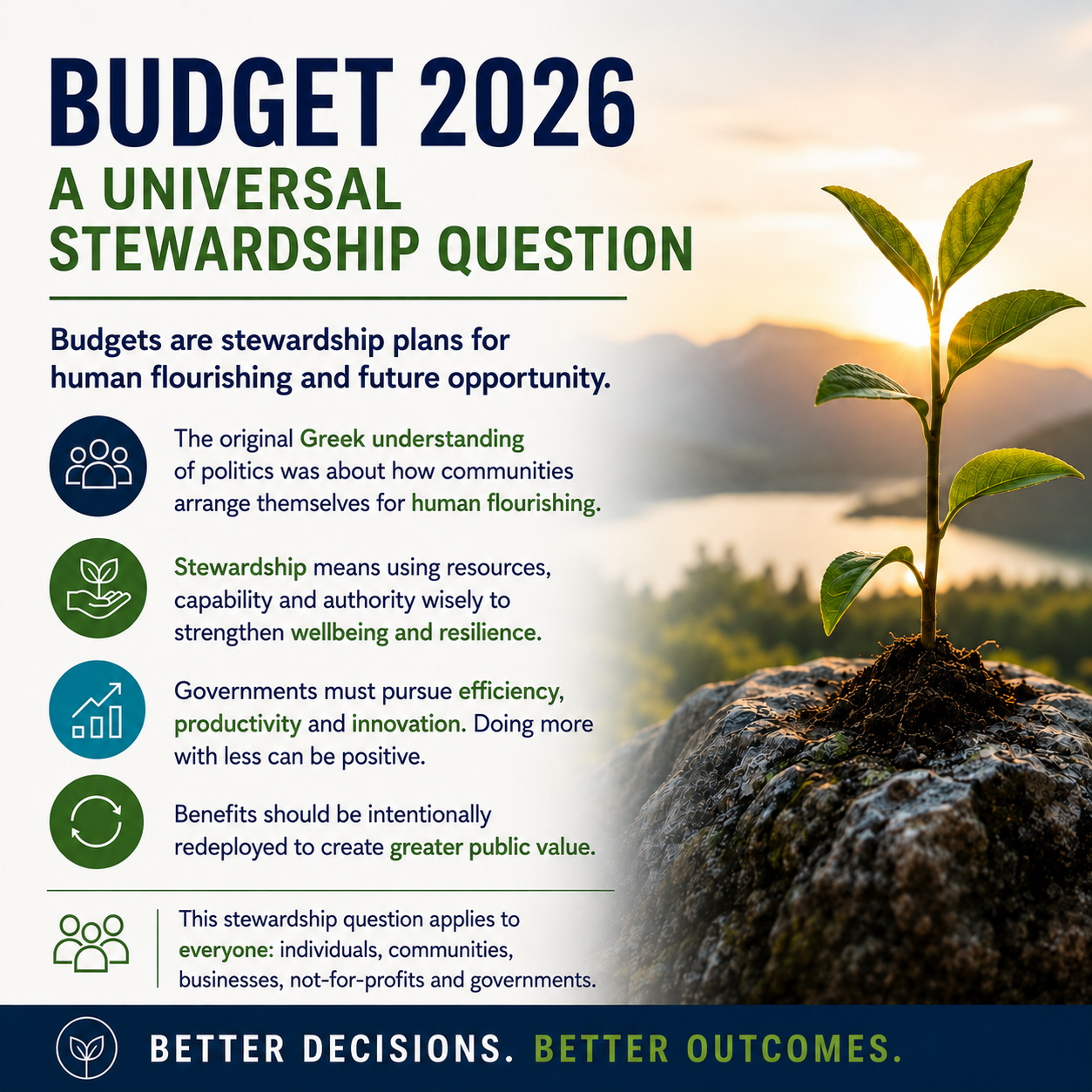
Budget 2026 should be more than a series of spending and spending-cut announcements.
It should reflect the results of a relational, systematic and holistic process for identifying how best to improve public value, showing how the Government will steward public resources, human capability and technological innovation to deliver Better Decisions and Better Outcomes for New Zealanders.
Yet Budget 2026 also points to a larger and more universal question:
How do we each faithfully steward what has been entrusted to us?
The original Greek understanding of politics was not primarily about party competition, political branding or short-term electoral advantage. At its core, politics concerned how communities arrange themselves for human flourishing.
Viewed through that lens, stewardship is the intentional and responsible use of resources, relationships, capability, authority and opportunity in ways that strengthen long-term wellbeing, resilience, trust, human dignity and future flourishing for others.
That question applies not only to governments, but to each of us. It applies to individuals, communities, businesses, not-for-profit organisations and governments alike.
At every level, the challenge is essentially the same. We have all been entrusted with resources, relationships, responsibilities and opportunities. The task of stewardship is to use them wisely, so they create value and contribute to the wellbeing of others.
The Government’s announcement that approximately 8,700 public sector roles are expected to be removed by mid-2029 makes this stewardship question particularly relevant.
The central issue is not whether government should pursue efficiency, productivity improvements, fiscal discipline or innovation. Responsible stewardship requires governments to use public resources wisely, adapt to changing conditions, and continually seek better ways of delivering outcomes for citizens and communities.
The deeper question is whether these changes will ultimately strengthen or weaken New Zealand’s long-term public value decision-making system.
The purpose of government is not simply to minimise administrative costs. Its purpose is to create public value by improving the wellbeing, resilience and long-term capability of citizens and communities. Staff numbers are an input. Public value is the outcome.
If artificial intelligence, digitisation and other innovations enable government to do more with fewer people, that can be a positive development. But the benefits should be intentionally stewarded.
Both the fiscal savings and the human capability released through restructuring should be redeployed in ways that strengthen New Zealand’s long-term economic, social, cultural and institutional capacity.
Public servants are not merely a cost to be reduced. They are also a significant national capability asset, carrying policy expertise, analytical capability, regulatory knowledge, institutional memory and a deep commitment to serving the public good.
Responsible stewardship therefore requires more than paying redundancy costs and leaving outcomes entirely to market forces.
Markets are important and often highly effective mechanisms for allocating resources, driving innovation and creating opportunity. But markets alone do not automatically preserve institutional knowledge, prevent underemployment, retain capability within New Zealand, or direct talent toward areas of highest long-term public value.
When government deliberately displaces thousands of skilled professionals, it assumes a stewardship responsibility to help ensure that this capability continues to contribute to national wellbeing where possible.
This raises a practical question for New Zealand: Where is the Public Value Stewardship Intention?
The need for such an intention is underscored by the current state of government decision-making. New Zealand has developed important tools and frameworks, yet persistent challenges remain fragmented decision-making, uneven capability, weak integration between long-term strategy, local and central government and communities, budgeting and delivery, and inconsistent links between expenditure and measurable outcomes.
Good intentions do not automatically produce good results. Better outcomes require a stronger public value decision-making system grounded in active stewardship, disciplined leadership, fit-for-purpose capability, community intelligence and robust public accountability.
Where is the integrated intention showing:
how AI and digitisation will improve productivity;
how critical capabilities will be preserved;
how displaced capability will be redeployed;
how fiscal savings will be reinvested;
how risks will be managed;
how outcomes will be measured; and
how New Zealanders will ultimately be better off.
The Minister of Finance, the Minister for the Public Service, the Treasury and the Public Service Commission all have important stewardship and accountability roles in ensuring these questions are addressed.
Ultimately, Budget 2026 invites all of us to reflect on a deeper truth. Whether we are stewarding our own lives, our families, our communities, our organisations or our nation, the same question applies: How do we faithfully steward what has been entrusted to us?
For government, the answer should be a clear Public Value Stewardship Intention expressed through budgets, legislation, investments and reforms.
For each of us, the answer lies in how intentionally we steward what we have in ways that strengthen others and contribute to human flourishing.
Better Decisions. Better Outcomes.