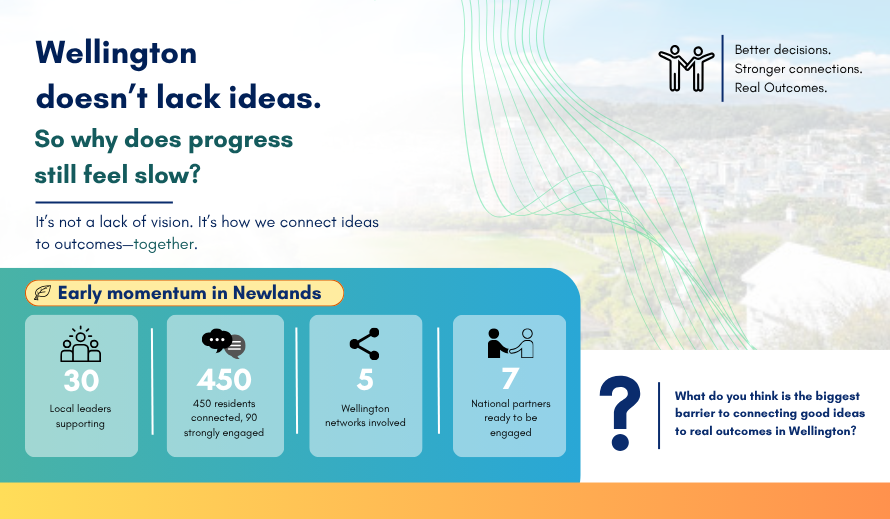
Wellington doesn’t lack ideas. So why does progress still feel slow?
Wellington doesn’t lack ideas. The recent Capital Crossroads series paints a vivid picture of a city full of ambition—gondolas, light rail, cultural anchors, revitalised precincts—alongside equally visible frustration. Plans stall. Projects fall away. Momentum fades. At the same time, the fundamentals are clear. Residents consistently point to what matters: infrastructure that works, safety, affordability, vibrant public spaces, and strong leadership. Business leaders highlight cost pressures, fragmentation, and the need for a more cohesive economic story. Community leaders remind us that a successful city is ultimately judged by how it treats its most vulnerable. None of this is new. What is becoming clearer, however, is that the challenge is not primarily a lack of vision. Nor is it simply funding, governance structures, or economic conditions—though all of these matter. The deeper issue sits beneath them.
A system problem, not just a project problem
Across Wellington—and, in truth, across much of New Zealand—a consistent pattern emerges:
· strong policy intent
· significant effort in planning and consultation
· but uneven translation into sustained, real-world outcomes
This is often described as a “delivery problem.” But that framing is incomplete. What we are seeing is a system problem—how decisions are connected (or not) from strategy through to outcomes.
Strategy, investment planning, and delivery are often treated as separate activities:
· strategies are developed, but not always clearly linked to prioritised investment portfolios
· business cases are prepared, but vary in quality and are not always anchored in long-term, place-based outcomes
· projects are delivered, but their cumulative impact on communities is not always well understood or measured
The result is what many people experience:
a city rich in ideas—but struggling to convert them into outcomes people can see and feel.
The cost of fragmentation
When decision-making is fragmented, several things happen.
First, confidence erodes. Communities see plans come and go. Businesses hesitate to invest. Leaders become cautious.
Second, trade-offs are made implicitly rather than explicitly. Decisions about infrastructure, housing, transport, and economic development interact—but are often assessed in isolation. This makes it difficult to understand the full impact on affordability, accessibility, and community wellbeing.
Third, short-term pressures dominate. Budget cycles, political cycles, and immediate constraints override long-term value—particularly when there is no shared, evidence-based view of what “better outcomes” look like over time.
This is not unique to Wellington. But in a compact, highly connected city like ours, the effects are more visible.
What the articles get right
The Capital Crossroads series surfaces several important truths:
· cities are about what people want—amenities, culture, connection, and experience
· infrastructure matters—but so do the basics: clean, safe, functioning public spaces
· Wellington’s strengths remain real: creativity, knowledge-intensive industries, and a strong sense of place
· there is growing recognition of the need for more coordinated leadership
But perhaps the most important insight is this:
we don’t just need more ideas—we need a better way of connecting them.
From projects to portfolios
One shift that could make a significant difference is moving from a project-by-project mindset to a place-based portfolio approach. Instead of asking: Should we build this project? We ask: What combination of investments, over time, will best improve outcomes for this place? This changes the conversation.
Economic, environmental, social, and cultural investments—and the infrastructure that enables them—can be considered together, not as competing initiatives, but as interdependent components of a shared outcome. It also makes trade-offs clearer, more transparent, and more grounded in long-term value.
The role of community-level evidence
Another theme running through the articles is the importance of what people actually experience.
This is where community-level evidence and lived experience become critical.
In Newlands, Paparangi, and Woodridge, local trends have been tracked across economic, social, cultural, environmental, and governance dimensions over time. What this suggests is something important: communities can be individually resilient, yet collectively vulnerable. Resilience is not just about infrastructure—it is about connection, trust, and capability. When this kind of evidence is brought into decision-making early, it strengthens both the quality of decisions and the legitimacy of those decisions.
Leadership as stewardship
The articles rightly point to leadership as a key factor. But leadership in this context is not just about making decisions. It is about stewarding the system within which decisions are made. That includes:
· ensuring decisions are connected from strategy through to delivery
· building capability across organisations
· creating space for long-term thinking alongside short-term pressures
· enabling genuine integration between central government, local government, and communities
Structural changes—such as council amalgamation—may help coordination. But structure alone will not resolve the underlying issue.
Without a more connected system, fragmentation can persist within any structure.
A moment of opportunity
Despite the challenges, there are reasons for cautious optimism. There are signs of:
· renewed investment in civic assets
· emerging business confidence
· strong participation in cultural life
· growing recognition that the current approach needs to evolve
Perhaps most importantly, there is a willingness to have this conversation openly.
From “fixing” to strengthening
Wellington does not need to be “fixed” in the way the narrative sometimes suggests.
It is already a city with strong foundations:
· high quality of life
· strong governance and environmental performance
· a highly skilled workforce
· a distinctive cultural identity
The task now is to strengthen how those strengths are translated into consistent outcomes over time.
The real crossroads
Wellington’s next chapter is not just about:
· more infrastructure
· lower costs
· new economic narratives
· or even new governance arrangements
It is about something more fundamental: how we make decisions together as a city. If we can better connect:
· strategy to investment
· investment to delivery
· delivery to measurable outcomes
· and all of this to the lived experience of communities
then many of the challenges described become more tractable.
And Wellington won’t just generate ideas—it will deliver outcomes people can actually see and feel.