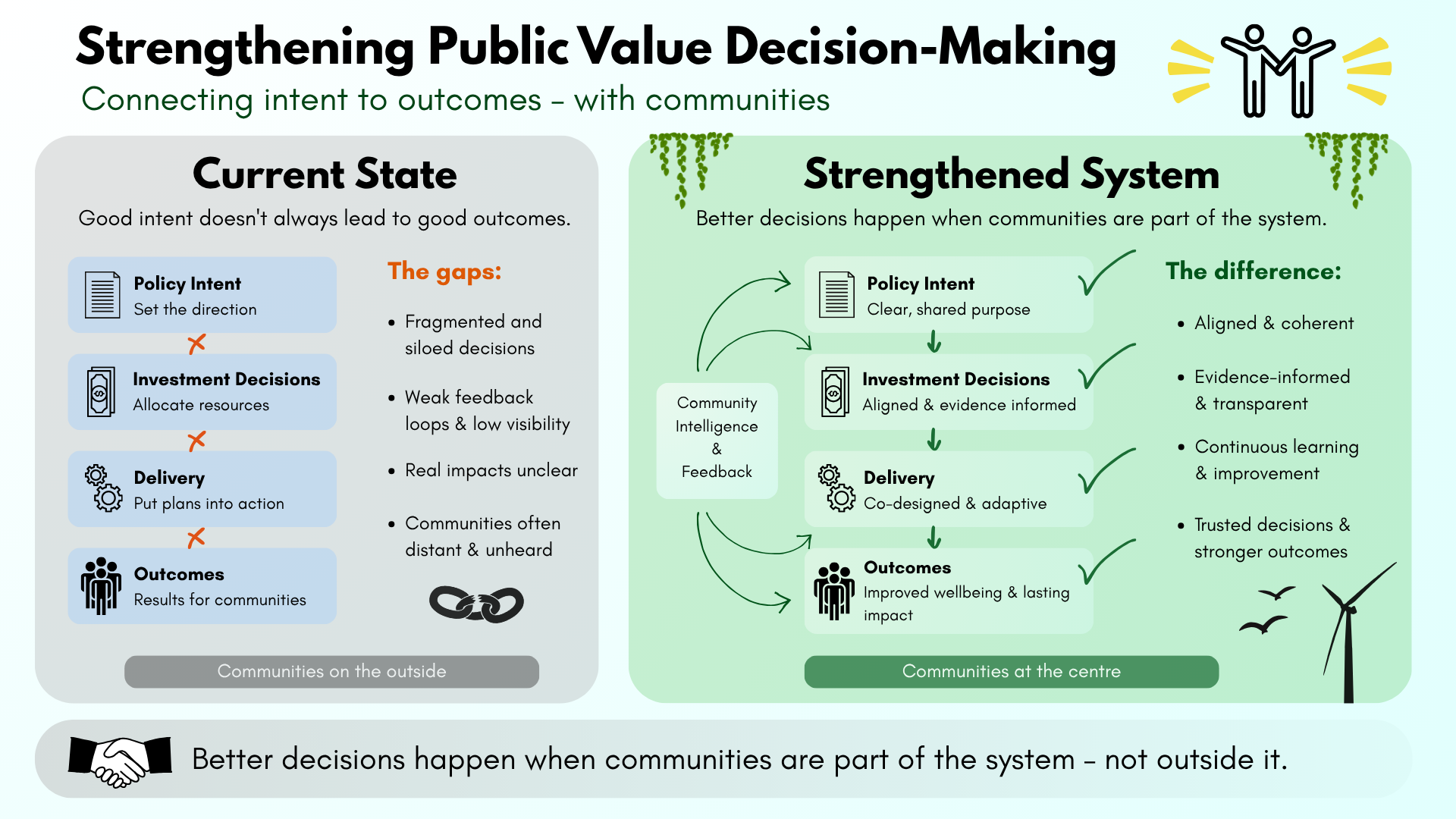
Across New Zealand, a consistent pattern is emerging.
We are often strong at setting policy direction. Significant effort goes into developing strategies, allocating funding, and designing initiatives. Yet the translation of that intent into sustained, real-world outcomes remains uneven.
This is not simply a delivery issue. Nor is it only about capability within individual agencies.
At its core, it is a system issue—how well our public value decision-making system functions as a coherent whole.
A recent note to Select Committees explores this question in more detail, focusing on how effectively our system connects decisions to outcomes over time.
A System, Not Just a Set of Processes
New Zealand’s legislative framework is clear.
The Public Finance Act 1989 and the Public Service Act 2020 establish stewardship responsibilities across the Minister of Finance, the Public Service Commission, and the Treasury. Together, these roles are intended to ensure that public decisions are robust, aligned, and deliver value over time.
In principle, this includes:
· clear alignment between strategy, investment, and delivery
· a consistent understanding of value for money
· strong capability across the system
· meaningful public accountability grounded in outcomes
However, in practice, a gap remains between the intent of this system and its consistent operation.
The Pattern: Fragmentation Across the Lifecycle
Evidence from government and other publications points to recurring challenges:
· variable quality of investment proposals
· weak integration between long-term planning, budgeting, and delivery
· fragmented decision-making across agencies and levels of government
· capability gaps in investment planning and delivery
· limited ability to consistently link expenditure to outcomes
Perhaps most importantly, key decision domains—Budget, investment, regulatory, and procurement—often operate through separate frameworks.
Each is valid in its own right. But they are not always aligned as part of a single, coherent system.
This creates real-world consequences:
· inconsistent definitions of value for money
· differing assumptions and evidence standards
· fragmented capability and duplicated effort
· difficulty connecting decisions across time and scale
A Missing Connection: Policy to Delivery
At its simplest, public decision-making follows a logical hierarchy:
· Policy defines the vision—what outcomes matter and why
· Portfolios identify the mix of programmes to achieve that vision
· Programmes coordinate projects to improve outcomes
· Projects deliver the assets and services
Where this chain is aligned, intent can translate into outcomes. Where it is not, the result is predictable: strong policy intent does not consistently lead to effective delivery or sustained impact. This is not about any one part of the system failing. It is about how well the parts connect.
What This Looks Like on the Ground: Newlands, Wellington
Over the past six years, this system-level question has been explored in a practical way in Newlands, Wellington.
Through a combination of community leadership, longitudinal evidence, and structured decision-making, several foundations have been built:
· a shared vision for community resilience
· annual survey data aligned to the Living Standards Framework
· identification of emerging trends through to 2030
· a co-designed implementation model now moving into delivery
The results reveal a pattern that is likely not unique:
· strong personal and social foundations
· underlying economic vulnerability
· low levels of collective action
· low disaster preparedness
· low institutional trust
Taken together, this suggests something important:
Communities can be individually resilient, yet collectively vulnerable—particularly when decision-making feels fragmented or distant from lived experience.
Why Community-Level Intelligence Matters
One of the clearest opportunities is to better incorporate community-level intelligence into decision-making.
This is not about replacing formal investment frameworks. It is about complementing them.
Community-level evidence and lived experience can:
· surface emerging risks earlier
· inform portfolio-level trade-offs
· highlight place-based impacts across programmes and projects
· strengthen alignment between national decisions and local outcomes
· build trust through greater transparency and relevance
This is beginning to emerge in current discussions with Waka Kotahi on the Petone to Grenada Link Road—where understanding impacts across economic, social, environmental, cultural, and governance dimensions is essential.
From Better Projects to Better Systems
Much effort across government is focused on improving individual projects or initiatives.
This matters. But it is not sufficient.
The larger opportunity is to strengthen the system itself.
A Public Value Decision System approach emphasises:
· active stewardship at Ministerial and system levels
· a clear lifecycle: Think → Plan → Do → Review
· alignment across policy, portfolio, programme, and projects
· fit-for-purpose capability at each stage
· relational principles (such as active listening)
· robust accountability linked to real-world outcomes
This is not about adding complexity. It is about creating coherence.
A Leadership and Stewardship Challenge
Ultimately, this is a leadership and stewardship question.
Formal structures matter. But they are not enough on their own.
Effective systems also depend on:
· disciplined judgement
· integrity in advice
· willingness to surface trade-offs and risks
· courage to maintain long-term focus under short-term pressure
At its best, public decision-making is grounded in a deep sense of responsibility for the wellbeing of people.
It is not only technically sound—it is connected to lived experience and trusted over time.
An Opportunity for Budget 2026
Budget processes provide a natural focal point for strengthening system coherence.
There is an opportunity to ask:
· Is there a clearly defined and actively stewarded public value decision-making system?
· Are policy, investment, regulatory, and procurement decisions aligned within it?
· Is capability consistent across agencies and levels of government?
· Is value for money defined and assessed consistently across the lifecycle?
· Are community-level insights systematically incorporated?
These are not abstract questions.
They go directly to whether public expenditure translates into meaningful, sustained outcomes.
Concluding Reflection
Fiscal discipline is often framed in terms of controlling expenditure.
But it also depends on something deeper: the quality, coherence, and foresight of the system that shapes decisions. Strong systems do more than respond to immediate needs. They anticipate future pressures and align decisions over time. This is where the greatest leverage lies. Ultimately, the question is not only whether we are choosing the right investments. It is whether we have a system capable of consistently turning good intent into real-world results.