
Stewardship in an Age of Complexity
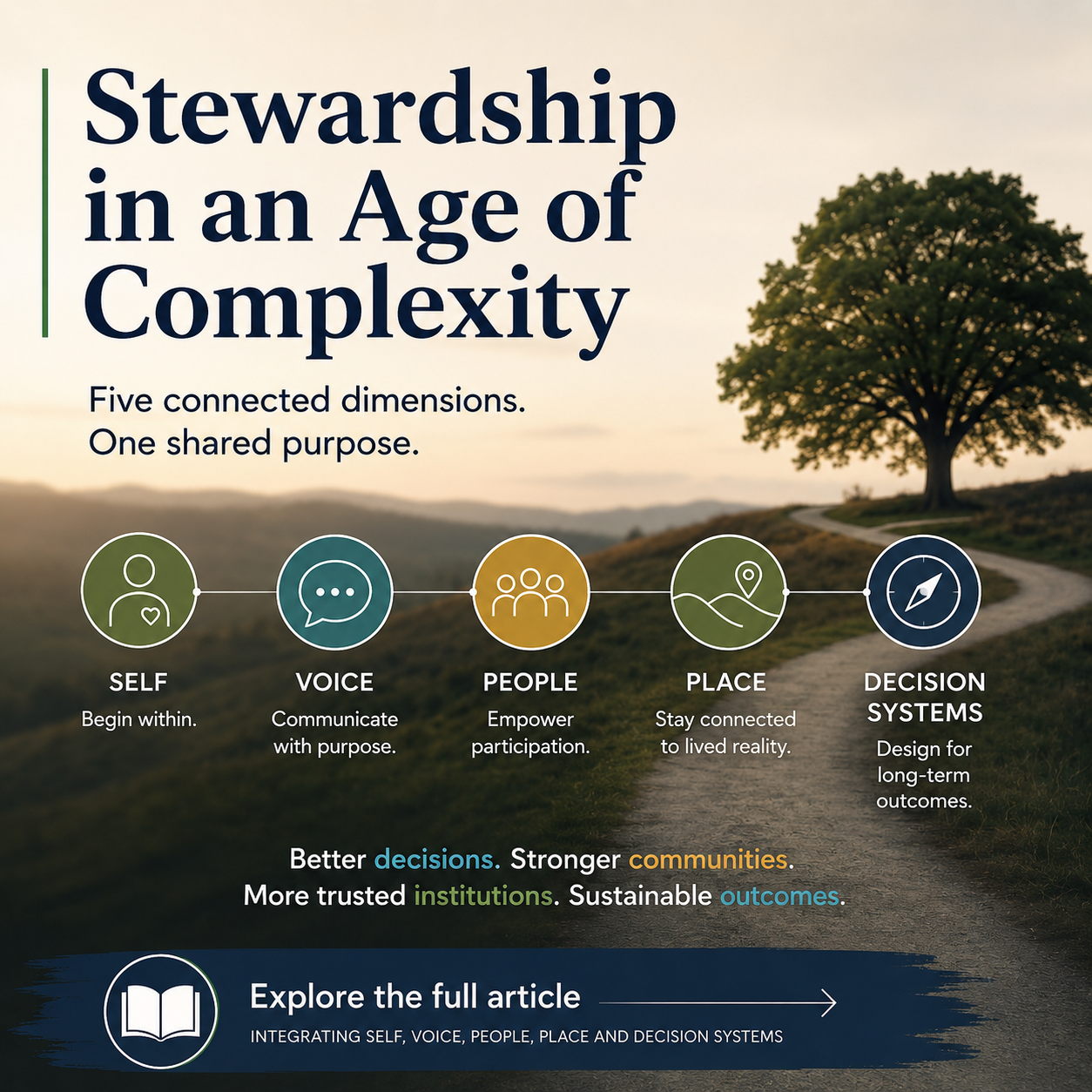
Integrating Self, Voice, People, Place, and Decision Systems
Over recent years, I have increasingly reflected on the relationship between personal stewardship, community wellbeing, and the quality of the systems through which decisions are made.
Through my work across government, communities, and public investment systems, I have repeatedly observed recurring challenges:
connecting long-term thinking with short-term pressures,
linking strategy with lived experience,
sustaining trust and participation over time,
and translating good intentions into meaningful outcomes.
These observations have gradually led me to think about stewardship more broadly — not simply as leadership or governance, but as a personal and collective responsibility expressed across several connected dimensions of life and society.
For me, five forms of stewardship increasingly stand out:
stewardship of self,
stewardship of voice,
stewardship of people,
stewardship of place,
and stewardship of decision systems.
I increasingly see these dimensions as interconnected. The quality of one often influences the strength of the others. Together, they shape the conditions that influence communities, institutions, decision-making, and long-term outcomes.
Stewardship of Self
Meaningful stewardship begins with how I steward my own life.
Before contributing constructively to organisations, communities, or systems, I need to take responsibility for my own integrity, wellbeing, motivations, relationships, emotional health, and capacity for reflection.
For me, stewardship of self involves regularly asking:
What anchors me during uncertainty or pressure?
Am I living consistently with what I say matters most?
Am I responding thoughtfully or merely reacting?
What responsibilities am I personally being invited to steward well at this stage of life?
This is not about perfection or self-importance. Rather, it reflects an increasing awareness that the condition of my inner life inevitably influences the way I engage with others, make decisions, and contribute to the environments around me.
I have come to believe that grounded people are more likely to help create grounded systems.
Stewardship of Voice
I have also come to see voice as a form of stewardship.
The way I communicate can either strengthen understanding, trust, participation, and thoughtful decision-making — or contribute to confusion, reaction, and division.
In many contexts today, there is strong pressure toward simplification, immediacy, and polarisation. Yet many of the challenges facing communities and institutions are complex and interconnected. They require communication that can hold nuance while still remaining understandable and accessible.
For me, stewardship of voice means communicating carefully, honestly, and constructively. It involves trying to:
illuminate rather than inflame,
connect rather than divide,
and strengthen understanding rather than deepen confusion.
It also requires humility and restraint — recognising that influence carries responsibility.
At times, stewardship of voice means asking better questions rather than rushing to provide answers.
Stewardship of People
I increasingly see that communities and organisations are fundamentally relational.
People are not simply stakeholders, consumers, or resources. They carry lived experience, insight, aspirations, concerns, relationships, and untapped capability.
Across many settings, I have observed how participation, trust, and shared ownership strengthen both resilience and decision-making over time. I have also seen how disengagement can grow when people feel disconnected from decisions affecting their lives.
For me, stewardship of people includes:
listening carefully,
creating space for participation,
strengthening capability in others,
encouraging trust and belonging,
and recognising the value of lived experience alongside technical expertise.
I do not see leadership primarily as control or authority. Increasingly, I see it as creating conditions that enable contribution, responsibility, and growth in others.
Communities appear to become more resilient when people see themselves not merely as recipients of decisions, but as active participants in shaping outcomes.
Stewardship of Place
Place matters deeply.
Communities are shaped not only by policy and infrastructure, but also by relationships, geography, history, culture, identity, and lived experience over time.
One of the strongest lessons I have taken from community work is the importance of place-based understanding. Communities often hold deep knowledge about emerging pressures, vulnerabilities, strengths, and opportunities that formal systems may not fully recognise on their own.
For me, stewardship of place involves paying attention to what is happening within communities over time:
What patterns are emerging?
What pressures are people experiencing?
What strengths already exist locally?
How well do institutions remain connected to lived reality?
I have increasingly come to believe that resilience is not built only through infrastructure or emergency response capability. It is also strengthened gradually through trust, participation, preparedness, local leadership, and social connection.
Ultimately, resilient societies are built community by community.
Stewardship of Decision Systems
One of the least visible — yet most significant — forms of stewardship concerns the systems through which decisions are made.
Across many institutions, I continue to observe challenges in connecting strategy, planning, investment, delivery, accountability, and long-term outcomes coherently.
At times:
policy becomes disconnected from implementation,
funding from outcomes,
delivery from lived experience,
and accountability from whether wellbeing genuinely improves over time.
For me, stewardship of decision systems involves strengthening the quality, coherence, transparency, and long-term orientation of decision-making itself.
This includes:
integrating strategy with delivery,
strengthening public investment discipline,
improving evidence and learning,
enabling participation,
clarifying accountability,
and maintaining focus on long-term outcomes rather than short-term activity alone.
I have increasingly come to see that decision systems are never purely technical. They also reflect values, incentives, relationships, assumptions, and beliefs about what matters most.
Better systems require stewardship as much as capability.
Bringing the Five Together
These five dimensions of stewardship are increasingly deeply interconnected to me.
Stewardship of self-shapes integrity and groundedness.
Stewardship of voice shapes understanding and trust.
Stewardship of people strengthens participation and capability.
Stewardship of place connects decisions to lived reality.
Stewardship of decision systems influences long-term outcomes.
When these dimensions become disconnected, gaps can emerge between people, institutions, decisions, and outcomes.
When they become better integrated, stronger foundations can emerge for:
healthier communities,
more trusted institutions,
better long-term decisions,
and greater resilience over time.
For me, stewardship is ultimately about taking responsibility for the condition and contribution of my own life while seeking to strengthen the conditions that allow people, communities, and systems to flourish responsibly and sustainably over the long term. Not through control or performance alone, but through integrity, participation, learning, responsibility, humility, and thoughtful decision-making.