
Community Intelligence: The Missing Link in Better Public Decision-Making
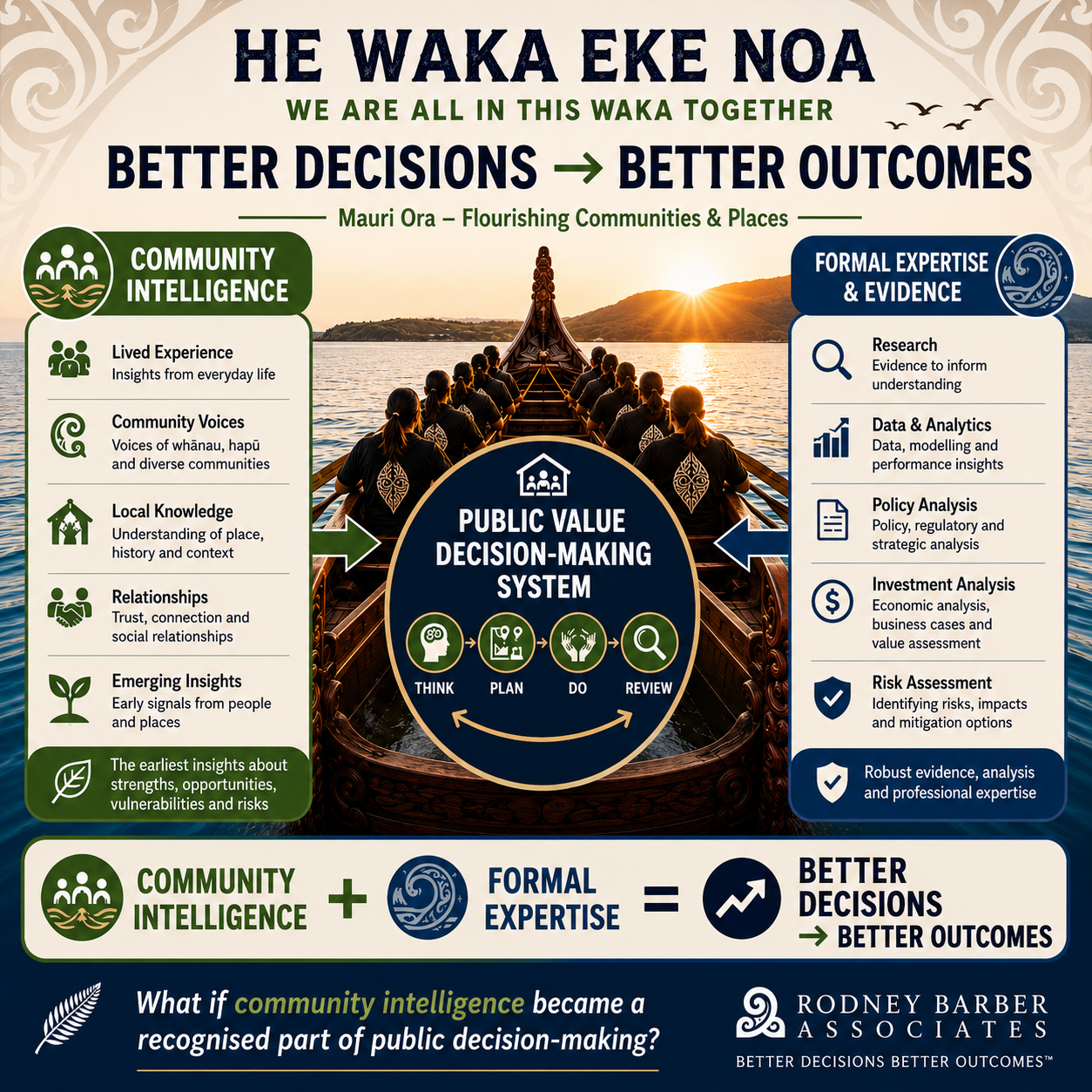
Governments, councils, and public agencies invest significant effort in improving decision-making. They commission research, analyse data, develop strategies, prepare business cases, and engage experts to guide investments and public policy.
These are essential components of good public administration.
Yet there is another source of intelligence that is often underutilised: the knowledge, experience, relationships, and observations that exist within communities themselves.
Communities experience change directly. They see how policies affect everyday life. They understand local strengths, vulnerabilities, emerging issues, and unintended consequences in ways that formal systems may not always detect.
This is what I describe as community intelligence.
Community intelligence is not simply consultation, engagement, or opinion gathering. It is the collective understanding that emerges from lived experience, community voices, local knowledge, relationships, community networks, and ongoing observation of what is happening in a place over time.
It is often where the earliest signals of change first appear.
Two Forms of Intelligence
Public decision-making has traditionally placed significant emphasis on formal expertise and evidence. This remains essential.
Research, data analytics, policy analysis, professional expertise, investment analysis, and risk assessment all play critical roles in understanding problems and evaluating options.
Professional expertise helps answer questions such as:
What is technically feasible?
What are the costs and benefits?
What risks need to be managed?
What outcomes are being sought?
What evidence supports different options?
Community intelligence helps answer different but equally important questions:
How are people actually experiencing change?
What matters most to local communities?
What strengths already exist?
What vulnerabilities may be overlooked?
What unintended consequences might arise?
What emerging issues are becoming visible before they appear in formal reporting?
Neither perspective is sufficient on its own.
Professional expertise without community intelligence can miss context, lived realities, and emerging issues.
Community intelligence without professional expertise can struggle to translate insights into effective policy, investment, and implementation decisions.
The opportunity lies in bringing both together.
He Waka Eke Noa: We Are All in This Waka Together
One way of thinking about public decision-making is through the image of a waka.
On one side sits community intelligence: lived experience, community voices, local knowledge, relationships, networks, and emerging insights.
On the other sits formal expertise and evidence: research, analytics, policy analysis, professional expertise, investment analysis, and risk assessment.
Neither paddle is sufficient on its own.
As the whakataukī reminds us:
"Kotahi te hoe, e kore te waka e ū ki uta."
"With one paddle alone, the waka will never reach the shore."
Better decisions emerge when both forms of intelligence work together within a public value decision-making system.
What Community Intelligence Looks Like
Community intelligence can take many forms:
Longitudinal community surveys
Local leaders identifying emerging concerns
Neighbourhood groups sharing observations
Community organisations seeing changing needs
Schools noticing shifts in family wellbeing
Businesses identifying economic pressures
Residents highlighting infrastructure, safety, or environmental issues
Individually these observations may appear anecdotal.
Collectively they can provide powerful intelligence about what is happening within a community and where future opportunities or risks may be emerging.
Lessons from Community Resilience
This has become increasingly apparent through the work of the Newlands Resilience Group and the Aotearoa Community Resilience Network (ACoRN).
Longitudinal community surveys and ongoing local engagement have highlighted patterns, vulnerabilities, strengths, and opportunities that may not otherwise be visible through conventional reporting mechanisms alone.
The lesson extends far beyond community resilience.
Whether the issue is infrastructure investment, housing, climate adaptation, public health, economic development, education, or social wellbeing, decision-makers are often operating within complex systems where both evidence and lived experience matter.
The strongest decisions are rarely informed by one source of intelligence alone.
They emerge when multiple forms of knowledge are brought together.
A Public Value Opportunity
Perhaps one of New Zealand's challenges is not a shortage of strategies, plans, expertise, or good intentions.
Perhaps the greater challenge is creating stronger connections between decision-making systems and the communities those systems exist to serve.
If public value is ultimately about achieving better outcomes for people and places, then community intelligence should not sit at the edge of decision-making.
It should be recognised as an important part of it.
Because when community intelligence and professional expertise work together, we create the conditions for better decisions, better outcomes, and flourishing communities and places.
He Waka Eke Noa. We are all in this waka together.