
Budget 2026 and Stewarding Human Flourishing Through Public Value
Connecting Public Value Systems, Better Decision-Making, and Resilient Communities
Reading Budget 2026 reinforced something I increasingly believe:
It is one thing to make announcements. It is another to have a genuinely connected public value decision-making system capable of turning investment into long-term outcomes.
Governments can announce infrastructure, resilience initiatives, reforms, regulations, and funding programmes. Many of these are necessary and well intentioned. Yet many societies, including New Zealand, appear to be experiencing increasing fragmentation between strategy and delivery, institutions and communities, investment and lived experience, and short-term pressures and long-term stewardship.
This raises an important question: What if communities were not treated as separate from public value decision-making systems, but as essential intelligence continuously informing them and speaking with their voices into decision-making?
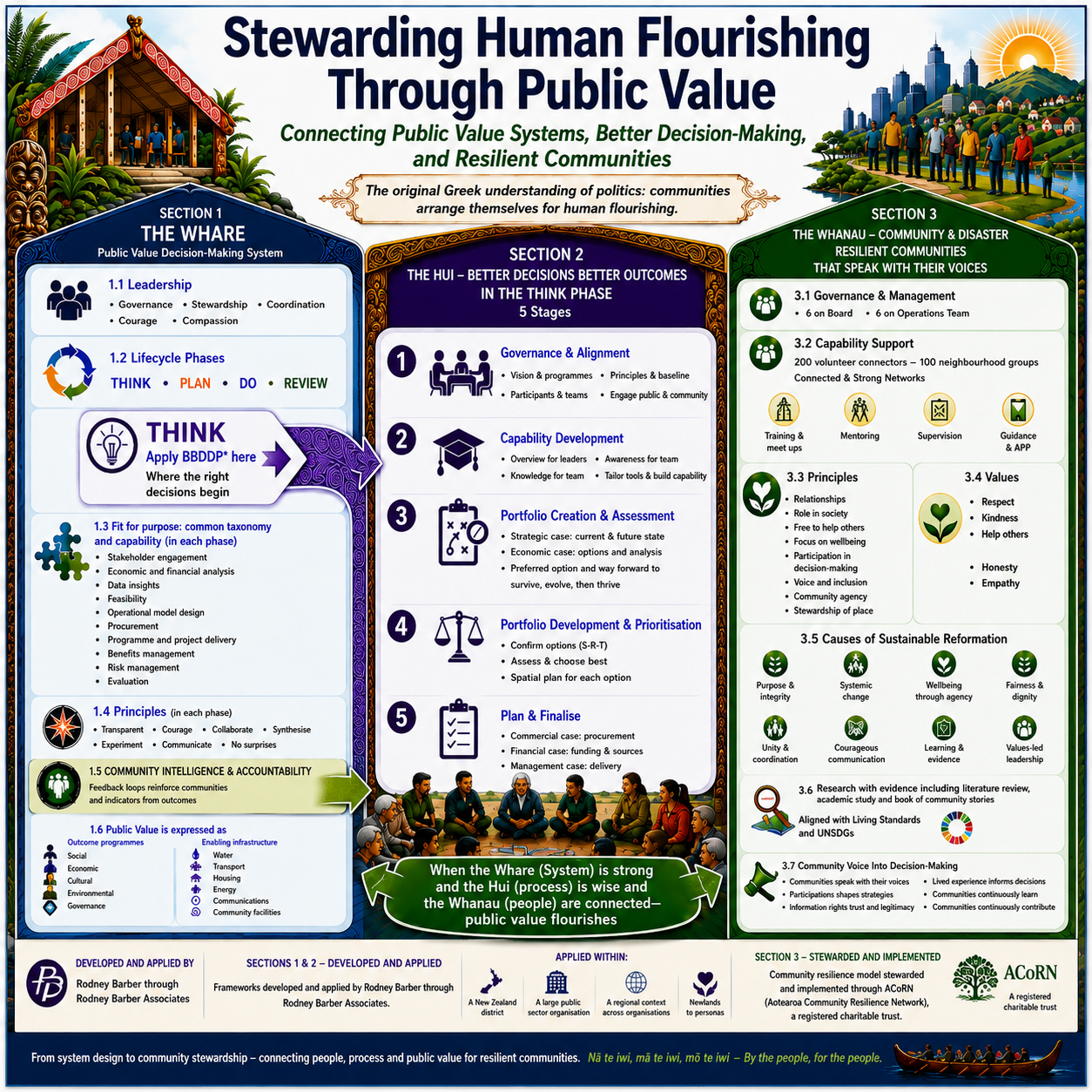
That question sits at the heart of the framework shown below.
Its central proposition is simple:
When the WHARE (system) is strong, the HUI (process) is wise, and the WHĀNAU (people) is connected — public value flourishes.
The WHARE — The Public Value System
The WHARE represents the wider public value decision-making system.
It encompasses leadership, governance, stewardship, capability, accountability, and lifecycle thinking across: Think → Plan → Do → Review
Strong systems provide the structures, disciplines, and capabilities needed to consistently translate decisions into outcomes.
Without a strong system, even good intentions can struggle to deliver lasting public value.
The HUI — Better Decisions Better Outcomes
The HUI represents the THINK phase, where important decisions are shaped before implementation begins.
It is where evidence, participation, strategic thinking, options, and alignment come together to improve decision quality.
My Better Decisions Better Outcomes (BDBO) approach focuses on strengthening this phase because better outcomes usually begin with better decisions.
The WHĀNAU — Community and Disaster Resilience
The WHĀNAU recognises that communities are not passive recipients of decisions made elsewhere.
Communities hold lived experience, local intelligence, relationships, capability, and insight.
Through the work of ACoRN and the Newlands Resilience Group, I have increasingly come to view communities as an important source of intelligence that can strengthen decision-making and long-term resilience.
Community resilience is not simply about disaster preparedness. It is also about connectedness, trust, participation, wellbeing, learning, and the ability of communities to adapt and thrive.
Community Intelligence as a Missing Link
A key feature of the framework is the feedback loop between communities and decision-making systems.
Too often, communities are engaged only after decisions have largely been shaped.
This framework suggests a different approach.
Communities continuously generate intelligence about wellbeing, resilience, risks, opportunities, and lived experience. When that intelligence informs decision-making, public value systems become more adaptive, legitimate, trusted, and effective.
This is not simply about consultation.
It is about stewardship, participation, accountability, learning, and trust.
When systems, decision-making, and communities remain connected, public value becomes stronger, wiser, and more sustainable.
Stewarding Human Flourishing
The original Greek understanding of politics was not primarily about party competition or electoral cycles. At its core, politics concerned how communities organise themselves for human flourishing.
That insight remains relevant today.
The challenges facing modern societies increasingly require stronger connections between public value systems, decision-making processes, and communities themselves.
My experience across public investment, Better Business Cases, community resilience, and public value decision-making continues to reinforce a simple lesson:
When the WHARE is strong, the HUI is wise, and the WHĀNAU is connected — public value flourishes.
Better decisions.
Better outcomes.
Better communities.