A lived experience of reflection and reframing
Grounded Life Stewarding has grown not only from my professional experience, but also from learning to apply reflection, discernment and intentional action to my own life.
One experience in particular has stayed with me.
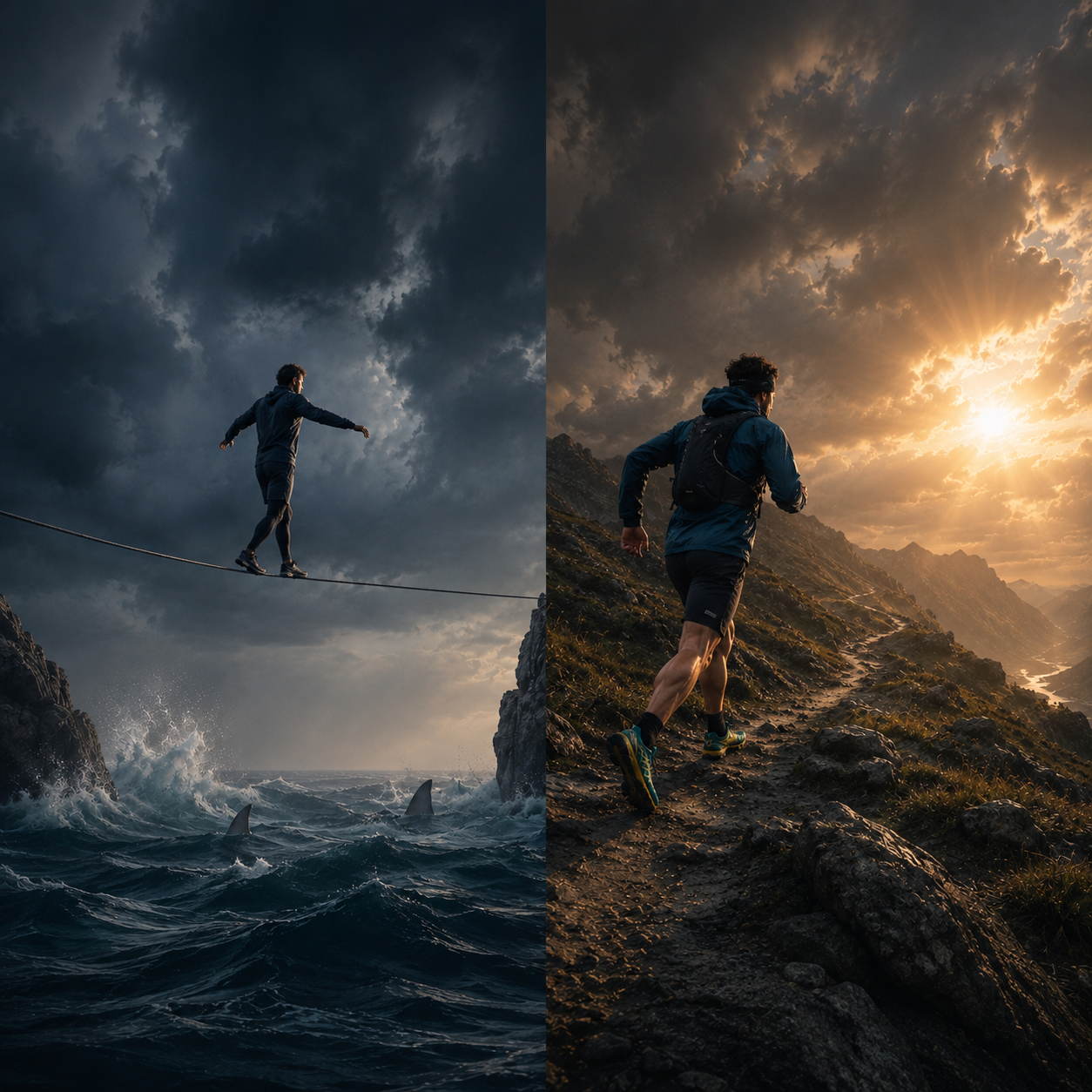
During a life-coaching course in 2025, we were invited to choose a photograph from a table that somehow represented our lives.
I chose a man walking a tightrope above a shark-infested ocean.
At the time, the picture felt remarkably accurate.
I cared deeply about contributing to human flourishing. I carried an ambitious vision of helping eliminate systemic poverty and contributing to an exuberant economy, thriving communities, vibrant cultures and a stunning environment.
But alongside that aspiration were some very real fears: Who am I to pursue something this ambitious? What if people don't understand what I am trying to communicate? What happens when people with influence resist thinking differently?
The image captured how I sometimes experienced the journey: precariously balancing on a narrow path, with significant consequences if I got things wrong and with people and systems around me seeming capable of frustrating the work I cared deeply about.
The facilitator encouraged me to reflect on the photograph overnight.
By the next morning, my perspective had changed.
I realised I wasn't walking a tightrope. I was on a lifelong trail run.
A lifelong trail run
A trail is very different from a tightrope.
It isn't straight, predictable or perfectly controlled. There are steep climbs, difficult terrain, changing weather, unexpected obstacles and moments of exhaustion. Sometimes you move quickly; sometimes progress is slow. Sometimes you need to stop, recover, reconsider the route or accept help.
But you are not expected to balance perfectly.
And the people around you are not sharks.
I began to recognise that everyone—including people whose decisions I might strongly disagree with—is navigating life with their own combination of capabilities, experiences, pressures and vulnerabilities. I could challenge decisions and advocate strongly for change without reducing people to opponents.
Something else shifted as well.
Instead of asking: “Who am I?” I could say: “I am Rodney. I am someone. I care.”
I did not need authority, recognition or universal agreement before making a worthwhile contribution. My responsibility was to bring what I had—my experience, abilities, relationships, values and compassion—and work humbly with others toward something that mattered.
I changed the image on my phone.
The tightrope walker was replaced by a trail runner: equipped for difficult conditions, supported by coaches and others along the way, and able to stop at aid stations to refuel, recover and continue the journey.
The circumstances had not necessarily changed. What had changed was how I understood myself, other people and the journey ahead.
That experience continues to shape how I understand coaching and Grounded Life Stewarding.
Sometimes we cannot immediately change the terrain around us. We can, however, become clearer about where we are going, recognise what we are feeling, examine the assumptions shaping our response, reconnect with what is true and important, and discern the next step.
That is the kind of movement the Six Reflective Questions are designed to support.
The aim is not a perfectly controlled life.
It is to become more grounded in who we are, clearer about what matters, better equipped for the terrain ahead, more open to travelling with others, and increasingly able to take the next wise and courageous step.
So perhaps the question is not: “What happens if I fall?” but: “What is the next grounded and courageous step?”
That is a question Grounded Life Stewarding creates the space to explore.
Reflect. Discern. Take the next wise step.