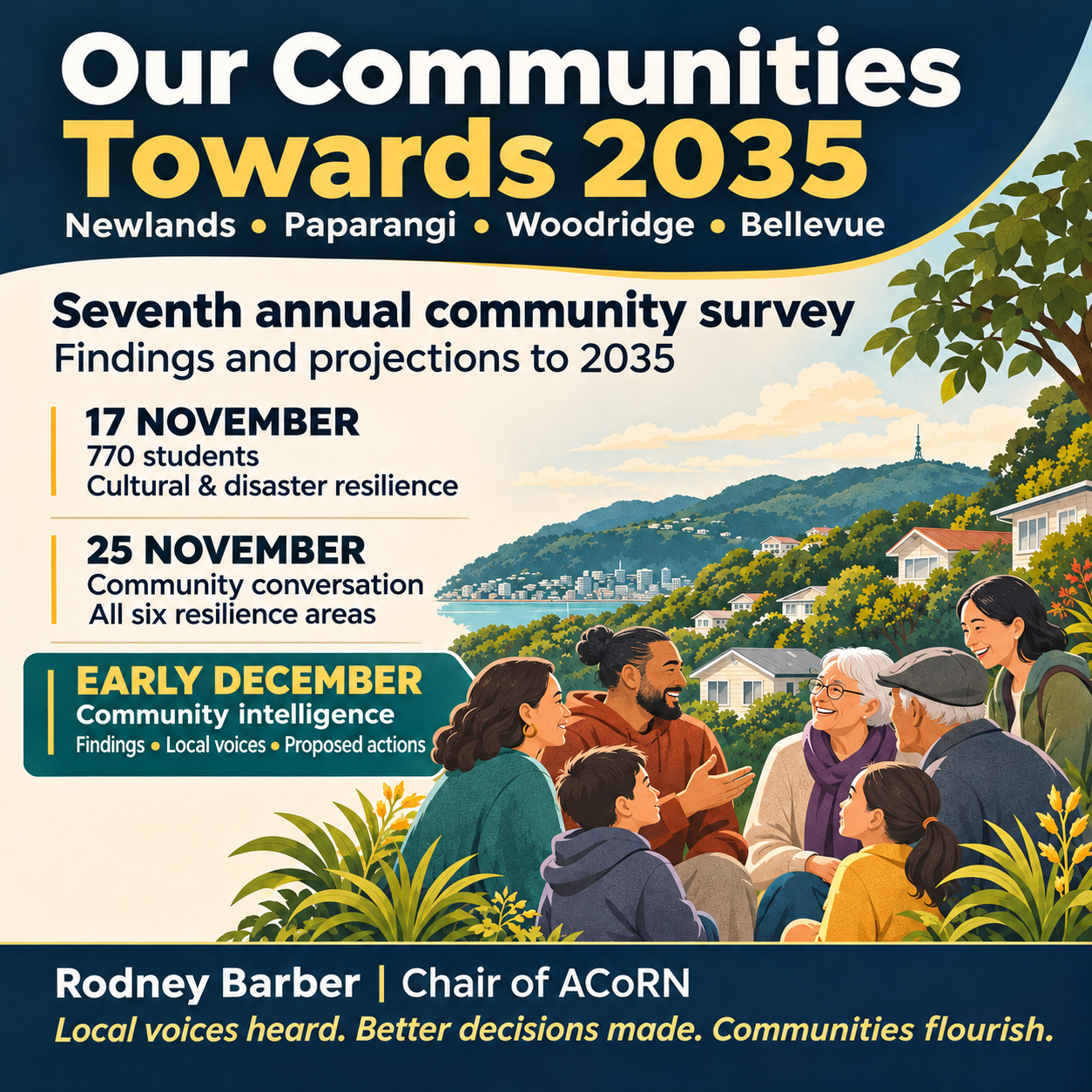
Our Communities Towards 2035
Rodney Barber, Chair of ACoRN
As Chair of ACoRN, I’m pleased to share our seventh annual community survey results, published today, 11 November. Using the Treasury Living Standards Framework, these include updated trends and projections to 2035 for Newlands, Paparangi, Woodridge and Bellevue.
The findings reveal strengths alongside emerging pressures. Understanding these contrasts requires the experiences and knowledge of people who live here.
What do the findings mean?
The survey covers six resilience areas: economic, environmental, cultural, social, disaster resilience and governance.
Trends show what has been changing since 2019. Projections suggest possible directions towards 2035, subject to assumptions and limitations. They do not determine our future, and survey responses cannot represent every experience.
Six questions will help guide our wider community conversation. The levels below refer to the survey indicators.
· Economic: Why might basic life skills, job satisfaction and paid working hours improve towards very high, while income satisfaction remains high and confidence in finding a new job declines within moderate?
· Environmental: Why might access to the natural environment improve within very high, water safety confidence remain high, and confidence in optimal land use improve from moderate to high?
· Cultural: Why might first-language capability remain very high, while belonging in New Zealand declines towards high, cultural participation and knowledge sharing fall towards very low, and te reo Māori use remains very low?
· Social: Why might freedom to be yourself in Newlands and New Zealand, meaning and purpose, personal control, life satisfaction, independence, mental health, safety, crisis support, work–life balance and travel-time satisfaction improve within high or very high, alongside low or very low discrimination and loneliness, while family wellbeing and leisure time decline within high and volunteering time declines within moderate?
· Disaster resilience: Why might home preparedness decline from moderate to low, preparedness where people spend time outside Newlands decline towards moderate, and neighbourhood support membership remain very low and decline further?
· Governance: Why might Police trust decline but remain high, council trust improve slightly within moderate, and government trust decline towards low? What, if anything, might these patterns mean for currently high general and local election turnout?
Hearing young people on 17 November
On Tuesday, 17 November, 770 intermediate and college students will explore cultural resilience and disaster resilience. Using accessible questions, we will explore whether the findings reflect their experiences, what might explain them, and what they would like to strengthen or change.
Wider community conversation on 25 November
On Wednesday, 25 November, residents will explore all six resilience areas, asking:
Do these patterns reflect our experiences?
What might explain them?
What can residents do together?
What action or support do we need from councils, government and others?
Some actions could begin within neighbourhoods: sharing skills, strengthening relationships and preparing for emergencies. Others may require partnerships, resources or changes in public services.
Connecting understanding with action
The resulting community intelligence will combine the findings, students’ perspectives on cultural and disaster resilience, wider residents’ perspectives and proposed actions.
This could inform public decisions and the proposed March–May 2027 trial of 40 Community Connectors across 20 neighbourhood groups, subject to funding and readiness.
Following through will require clear responsibilities, resources and feedback about how residents’ contributions inform decisions.
Watch this space for the community intelligence we will publish in early December.
Local voices heard. Better decisions made. Communities flourish.