We talk about resilience strategies, community capability, preparedness, participation, social cohesion, and public value. We discuss what resilient communities might look like and why they matter.
These conversations are important.
But an equally important question is this:
What does community resilience look like in practice?
For the past six years, residents in Newlands, Wellington, have been exploring that question.
The journey did not begin with a funding programme, a government initiative, or a predetermined model.
It began with a desire to better understand the community itself.
Using annual surveys aligned to recognised wellbeing and resilience indicators, residents gathered information about how people viewed their community, their wellbeing, their preparedness, their relationships, and their confidence in various aspects of community life.
Over time, a clearer picture emerged.
The data revealed many strengths. Residents generally reported positive wellbeing, strong access to natural spaces, and a high degree of personal independence.
At the same time, several vulnerabilities consistently appeared.
Neighbourhood connections were weaker than many expected.
Participation in helping others was lower than desired.
Preparedness levels varied.
Trust in some institutions was limited.
Confidence in aspects of economic security and local resilience was mixed.
These findings helped move conversations beyond assumptions and anecdotes.
They created a shared evidence base from which residents could begin discussing priorities and potential responses.
Importantly, the goal was not simply to identify problems.
The goal was to understand what public value might look like for the community and how it could be strengthened over time.
This led to a broader conversation involving residents, community organisations, local leaders, and supporting partners.
One conclusion became increasingly clear.
Many of the challenges identified were interconnected.
Preparedness was linked to relationships.
Relationships were linked to participation.
Participation was linked to trust.
Trust was linked to community capability.
Capability was linked to resilience.
Addressing any one issue in isolation was unlikely to create lasting change.
A more coordinated approach was needed.
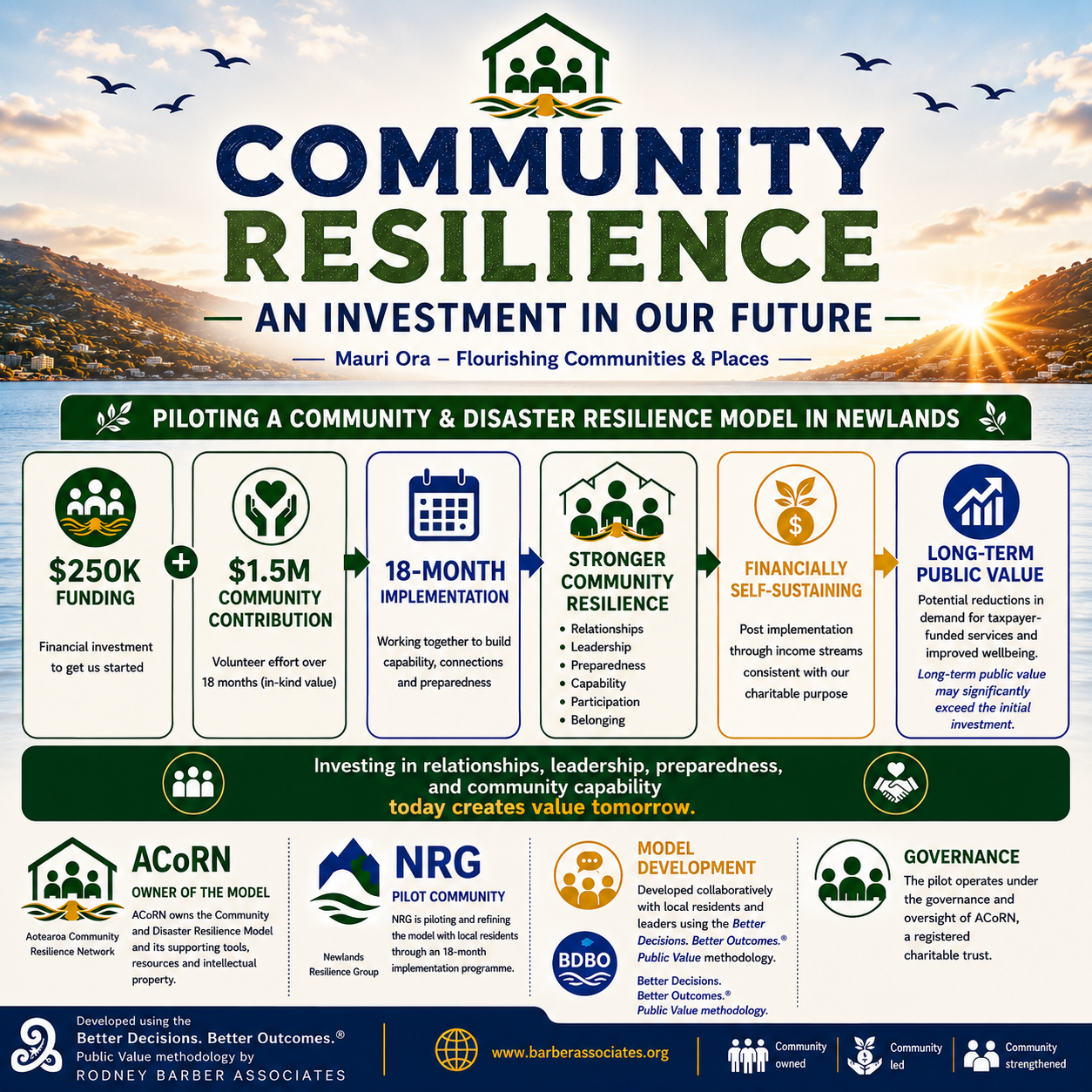
This insight ultimately led to the development of a Community and Disaster Resilience Model through the Aotearoa Community Resilience Network (ACoRN), a charitable trust.
The model seeks to strengthen resilience through a combination of community connections, local leadership, neighbourhood engagement, volunteering, preparedness, mentoring, community intelligence, and ongoing measurement.
The approach is deliberately long-term.
The objective is not to deliver a one-off project.
The objective is to strengthen the conditions that enable communities to thrive, adapt, and respond effectively to future challenges.
Importantly, Newlands remains a work in progress.
The community has not solved every challenge.
Many aspects of the model are still being implemented and refined.
Like any meaningful change effort, progress requires patience, learning, collaboration, and persistence.
Yet there are already valuable lessons emerging.
First, communities possess significant knowledge and insight about their own circumstances.
Second, data can help inform a shared understanding of priorities and opportunities.
Third, resilience is about far more than emergency response.
It includes relationships, leadership, participation, trust, wellbeing, and collective capability.
Finally, community resilience can be intentionally developed.
It is not simply something communities either have or do not have.
As governments, councils, and organisations consider how best to strengthen resilience, Newlands offers a practical example worth observing.
Not because it provides a perfect model.
Not because every lesson will apply elsewhere.
But because it demonstrates that communities can move beyond consultation and become active participants in understanding, shaping, and strengthening their own future.
That may be one of the most important resilience lessons of all.
If you have questions, or are aware of great examples elsewhere that we may also be able to learn from, we invite you to get in touch