Organisations, Cities & Nations
Better decisions are those that are defined within a vision. They are better considered and coordinated decisions leading to greater confidence by:
public leaders “turning intent into outcomes”
key stakeholders willing to “work with public leaders”
suppliers willing to “engage commercially and contribute to community needs”
non-government investors willing to “co-invest”
public assurance that “scarce resources are invested to best meet needs”
What are Better Decisions?
-
To capture full economic potential, reduce unemployment, and increase disposable incomes.
-
Achieve a sense of “our place” with effective stewardship of natural resources.
-
Meet people’s needs so they can reach their full potential.
-
Achieve Maori potential. Be socially cohesive. Expand Community integration initiatives. Further celebrate diversity.
Who benefits from better coordinated and considered decision making?

Public Leaders
Public leaders gain greater confidence that they can deliver on time and within budget to achieve the intended benefits.

Non-Govt Investors
Non-Government investors gain more confidence to trust and subsequently co-invest with Government.

Key Stakeholders
Key stakeholders and Suppliers gain more confidence they can work with and trust Public Leaders

The Public
The public have greater confidence that scarce public money is being invested in a way that will increase their living standards.
Organisations, Cities & Nations
Option 1: Establishing Better Decisions Better Outcomes (BDBO)
This engagement supports leaders to strengthen the way decisions are made by embedding the 5-stage BDBO framework within their existing public value decision-making system.
Outcomes
Improved clarity about desired outcomes
Stronger evidence-informed decision-making
Greater confidence in navigating complexity and trade-offs
Enhanced alignment between strategy, investment, and delivery
Nature of the Engagement
Short-term, high-trust coaching
Focused on improving confidence and clarity in decision-making
Not facilitation, training, or report-writing
Investment
1 day per week for 2 months
$1,500 per day
$12,000 per engagement
Option 2: Applying Better Decisions Better Outcomes (BDBO)
This engagement supports leaders to apply the 5-stage BDBO framework to a real decision agenda, embedded within their existing public value decision-making system.
Outcomes
Better decisions on real strategic issues
Improved management of trade-offs and uncertainty
Increased organisational learning and capability
Better outcomes for communities, customers, or citizens
Nature of the Engagement
Medium-term, high-trust coaching
Focused on real decisions, trade-offs, and implementation learning
Builds internal leadership capability and confidence
Not facilitation, training, or report-writing
Investment
1 day per week for 5 months
$1,500 per day
$50,000 per engagement
How Rodney Works with Leaders
RBA works with leaders who are willing to face complexity honestly, make difficult trade-offs transparently, and steward decisions for the long-term public good.
Rodney brings experience from central government, international public investment management, community resilience, and public value decision-making.
His role is not to tell leaders what to decide, but to help them think more clearly, act more confidently, and make better decisions that lead to better outcomes.
This work is relational, decision-focused, and grounded in public value rather than short-term optimisation.
What we do
Our Mission
At Barber Associates, we believe that the way to achieve better outcomes is through better decisions. We care about those who are vulnerable economically, socially and/or culturally and want to be part of the solution to eliminate the system of poverty that keeps them trapped so they can be all they are meant to be.
To this end, we created “Better Decisions. Better Outcomes”, a proven 5-stage method that enables public leaders to take a holistic, systematic, relational approach to engage and think with key stakeholders how best to achieve vision for better public value. It produces a Portfolio Business case to inform initiatives that require investment and policy decisions.
Dr. Joe Flanagan-Joint Chief Examiner of the UK Better Business Case Programme, Architect of the 5 Case Model, and author of the HM Treasury Guides for the development of Programme and Project Business Cases-fully endorses BDBO approach to the development of Portfolio Business Cases.
One of the mistakes we most often see is that business cases are written as a compliance document to secure funding rather than a campaign to deliver public value. If you focus on the funding, you will miss your funding target. If you focus on thinking through public value, you’ll get the investor wanting to invest more. Engagement is key and is just one of the elements we assist with.
Key Benefits
There are 8 distinct advantages of the Barber Associates Engagement Model:
Capability- It delivers capability so less consultancy support is needed in future.
Clarity-It enables clarity of the dependencies between the initiatives enabling the leadership team to determine the overall value of the projects.
Confidence- It ensures the right initiatives are identified from the get-go.
Engagement- It engages stakeholders in the short and long term.
Fiscal -It helps prioritise with tight budgets.
Participation- It enables increased public participation.
Transparency- It provides rapid scenario planning with trade-offs between initiatives.
Vision-It better places the development of long-term planning.
Our 5 Stage Engagement Model
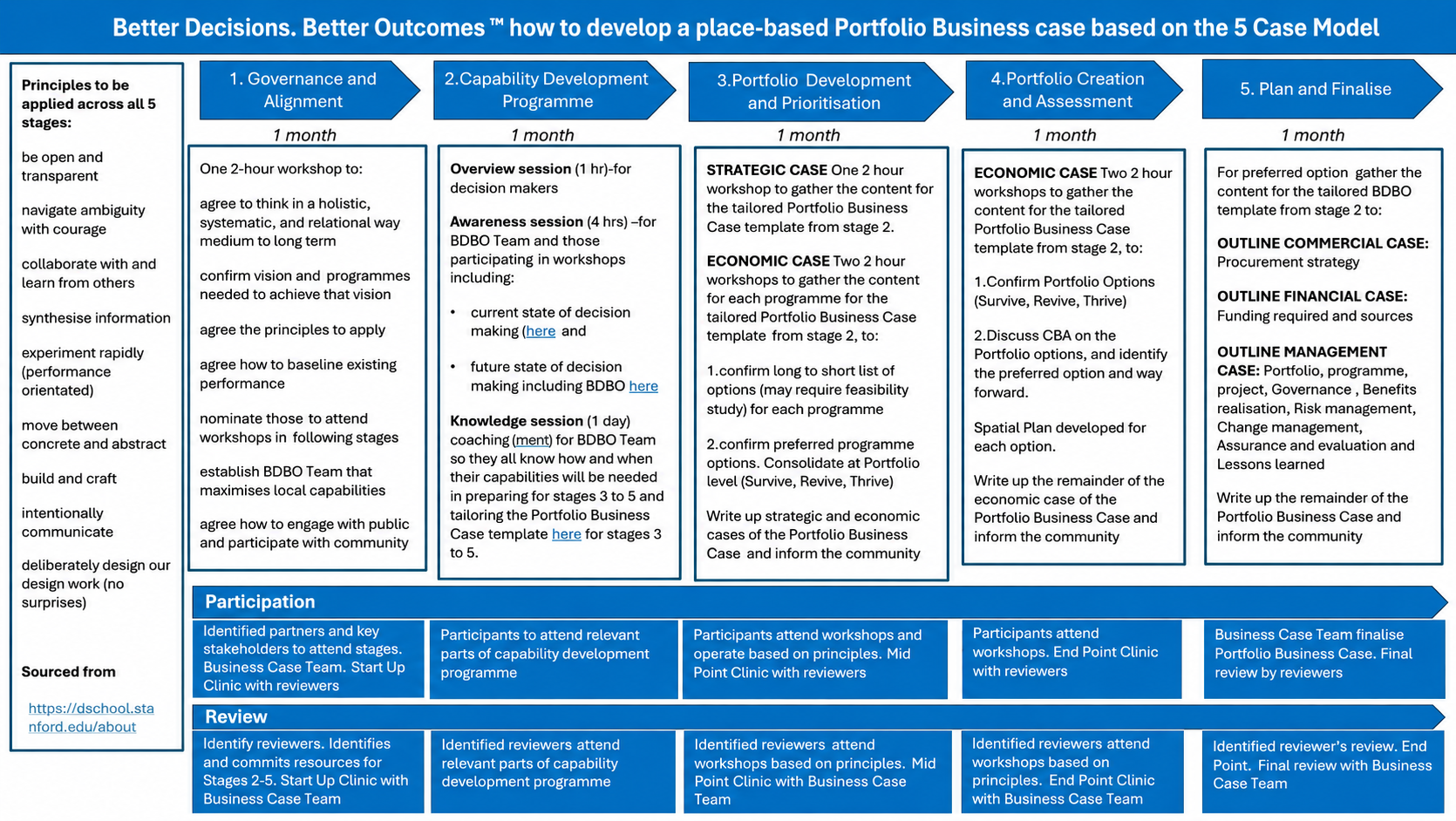
We have a tried and tested engagement model with a simple 5 stage approach, with a large associate base whilst maximising local people to enable public leaders to develop a place-based Portfolio Business Case in 5 months using the 5 Case Model. As part of our unique approach, we assess and improve the quality of your decision making, and train and coach you in developing your business whilst maximising your internal capability.
BDBO addresses the why, what, when, how and who of decision making in the think phase. The 5 BDBO stages carefully set out the importance of engaging the right people in the right way (who) to think together to develop a business case (what) to inform a startup decision (when) that gives confidence the vision can be achieved (why).