
Who Should Invest in Community Resilience?
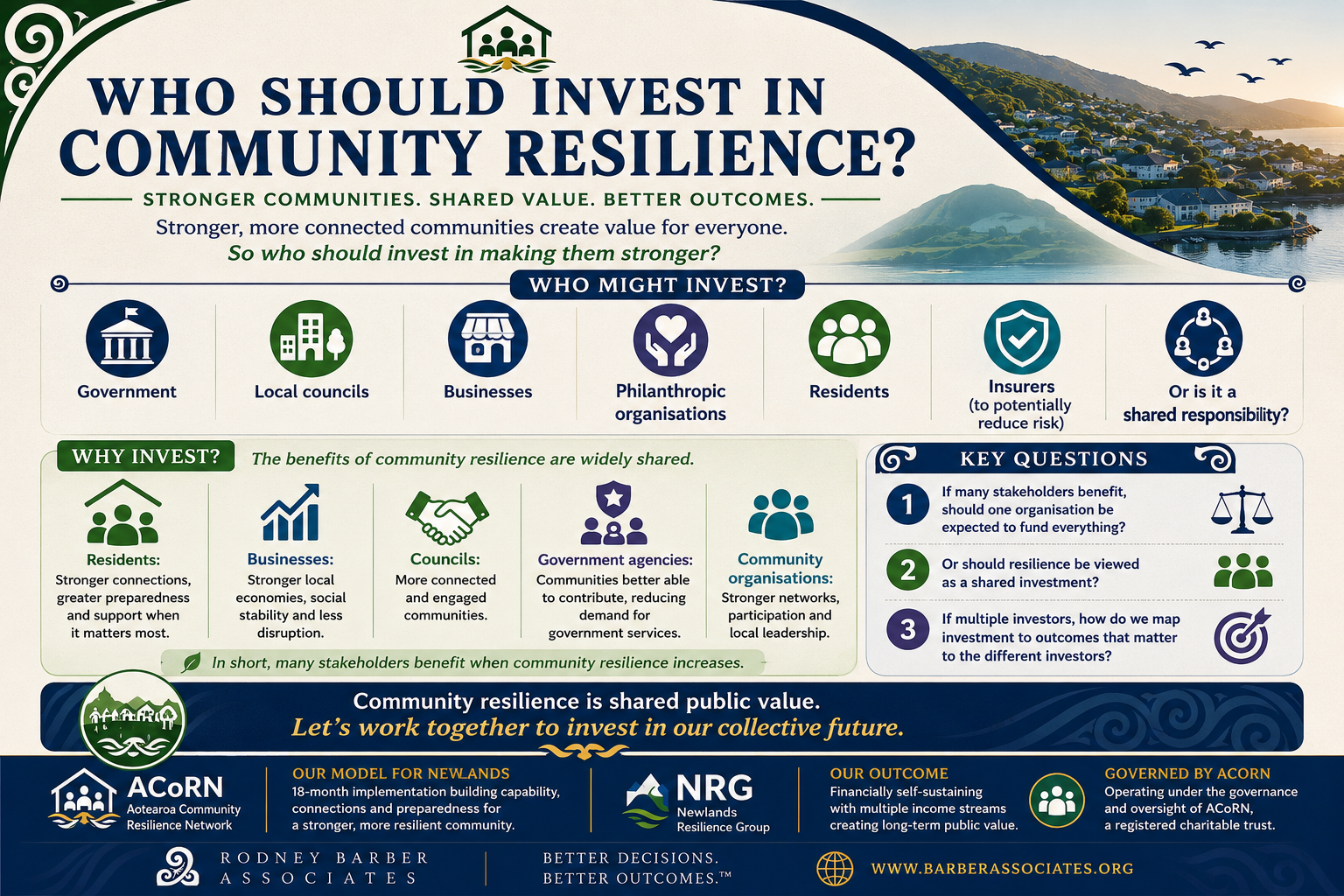
Every community benefits from resilience. The real question is not whether resilience matters, but who should invest in creating it.
Communities that are connected, prepared, capable, and able to work together are generally better positioned to respond to disasters, adapt to change, support vulnerable residents, and contribute positively to local wellbeing.
The challenge is rarely convincing people that resilience is important.
The challenge is deciding who should pay for it.
Over the past two years, the Aotearoa Community Resilience Network (ACoRN) and the Newlands Resilience Group have engaged with local government, central government agencies, community organisations, and philanthropic funders to explore support to implement a Community and Disaster Resilience Model. The conversations have been constructive.
Across our discussions with government agencies, councils, community organisations, and philanthropic funders, there has been broad recognition of the importance of community resilience and strong support for strengthening preparedness, neighbourhood connections, local leadership, participation, and community capability.
Yet securing significant upfront investment has proven difficult.
This experience highlights a challenge faced by many community-led initiatives.
Community resilience does not fit neatly into traditional funding categories.
It is not solely emergency management, social services, community development, health, wellbeing, education, or local government. It contributes to all of them.
As a result, responsibility for funding resilience often becomes unclear.
Yet the benefits of resilience are broadly shared.
Residents benefit from stronger neighbourhood connections and greater preparedness.
Businesses benefit from stronger local economies, social stability, and reduced disruption.
Councils benefit from more connected and engaged communities.
Government agencies benefit when communities are better able to contribute to positive outcomes and respond to challenges, reducing demand for government services.
Community organisations benefit from stronger networks, participation, and local leadership.
In short, many stakeholders benefit when community resilience increases.
This raises an interesting question.
The difficulty is that while the costs of building resilience are often visible upfront, many of the benefits are shared across multiple organisations and emerge over time. No single organisation captures all of the value created, even though many benefit from it.
If many stakeholders benefit, should one organisation be expected to fund everything?
Or should resilience be viewed as a shared investment?
That question sits at the heart of ACoRN's revised strategy to fund the implementation.
Rather than relying on a single major funder, the proposed approach seeks to build a coalition of contributors including residents, community champions, strategic partners, sponsors, supporters, and aligned organisations.
The underlying principle is simple.
Those who value stronger communities may be willing to contribute toward creating them.
Some contributions may be financial.
Others may involve expertise, mentoring, facilities, technology, communications support, volunteer time, research, or partnerships.
The goal is not dependence on a single source of funding.
The goal is shared ownership.
For Newlands, the initial implementation requirement is approximately $250,000 over eighteen months, with the longer-term intention of developing a financially sustainable operating model supported by multiple recurring income streams. Whether this approach succeeds remains to be seen.
However, it points to a broader issue facing communities across New Zealand.
We often talk about the importance of resilience.
We encourage preparedness.
We acknowledge the value of strong communities.
But we spend far less time discussing how resilience should actually be funded.
Perhaps that conversation needs to change.
Because if resilience is genuinely valuable, then funding resilience is not simply a matter of expenditure.
It is a matter of investment.
And investors invest because they believe value will be created.
The value may be social. It may be economic. It may be stronger preparedness, greater participation, improved wellbeing, increased trust, reduced vulnerability, or better long-term outcomes. Different people will value different outcomes.
But all are investing in the future of their community.
Which brings us back to the central question.
If resilience creates value for residents, businesses, insurers, councils, government agencies, and community organisations, perhaps the real challenge is no longer whether communities should invest in resilience, but how we map investment to outcomes that matter to the different investors?
I'd be interested in hearing how others think this could work.