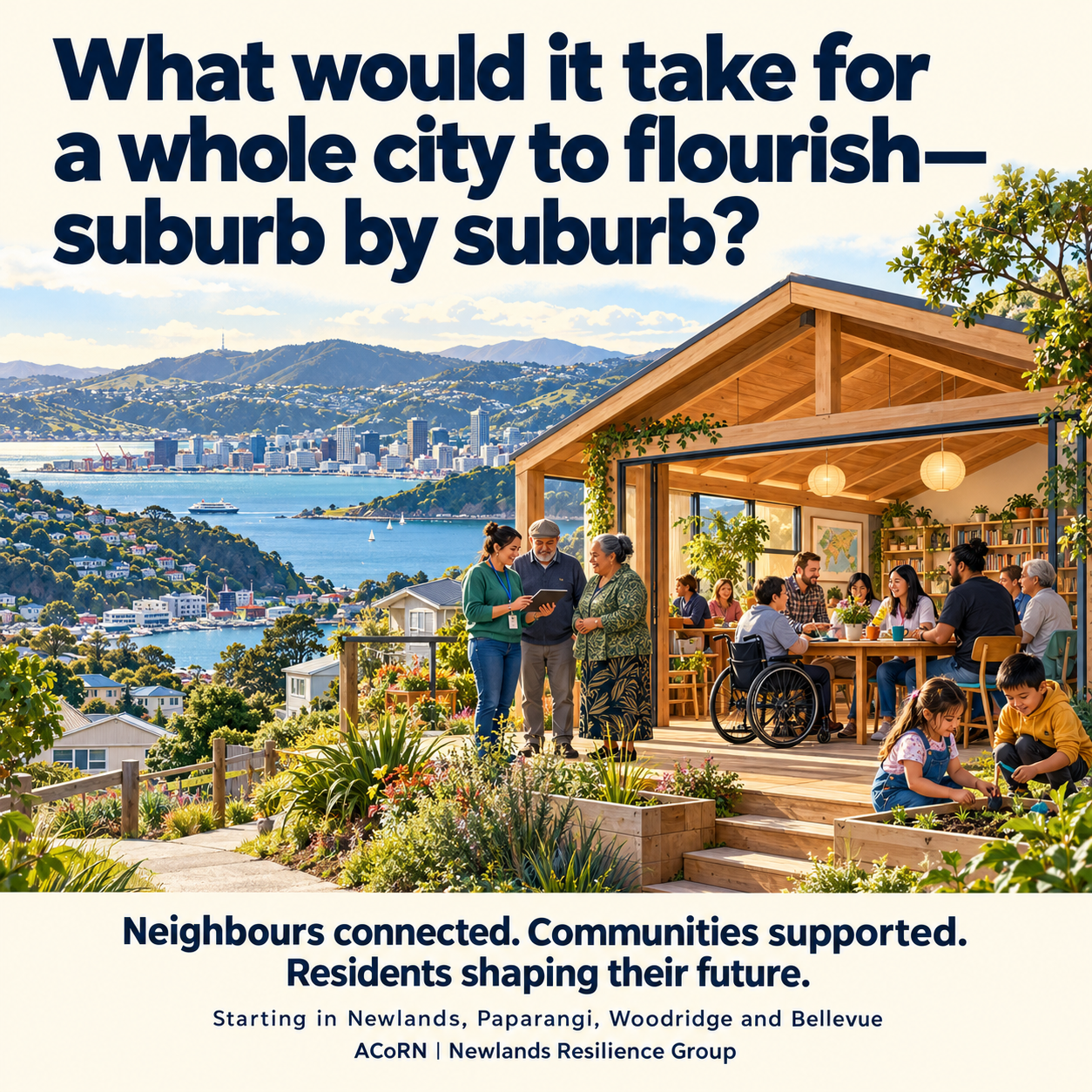
What would it take for a whole city to flourish—suburb by suburb?
Imagine Wellington as a city where neighbours know one another, people find opportunities to contribute, local businesses thrive, and shared spaces and cultural life bring people together. A city where support is close at hand when life gets difficult—and communities are better prepared when disaster strikes.
In my last two posts, I explored stronger communities, better decisions and the investment needed to support them, including in Who could help us secure investment in stronger communities? Now, I want to explore the wider possibility: a whole city flourishing, suburb by suburb.
Our proposed starting point is Newlands, Paparangi, Woodridge and Bellevue, through Aotearoa Community Resilience Network (ACoRN) and Newlands Resilience Group.
Our ambition is improved economic, environmental, social and cultural wellbeing, stronger disaster preparedness, and community intelligence that helps government make better decisions.
Building the whare together
Think of our approach as building a whare together. ACoRN helps put the foundations, walls and roof in place—the coordination, tools and support that help neighbourhood groups get established and stay connected.
Community Connectors would bring residents together to shape the whare’s use, influence its structure, fit it out and bring it to life through their skills, cultures and aspirations. Residents decide what matters locally and what they want to do together: sharing skills, caring for local spaces, organising cultural activities or supporting neighbours.
Connectors would co-develop an app and receive initial training and support during the trial. Subject to funding, implementation would introduce quarterly training and gatherings, monthly mentoring, professional group supervision and individual wellbeing plans. These arrangements would help volunteers contribute sustainably, recognise their limits and seek appropriate help. Wider outcomes also require partnerships, resources and services beyond each neighbourhood.
Community intelligence for better decisions
Residents know their suburb through everyday experience. Their knowledge can reveal strengths, barriers and priorities for action.
Our surveys gathered 1,163 responses between 2019 and 2025. Respondents identified strengths alongside opportunities to improve mutual support, cultural participation and disaster preparedness.
Our next survey runs from 21 October to 4 November, followed by a community conversation in November.
Together, surveys and conversations can develop community intelligence that complements professional expertise and other evidence in government decisions, helping decision-makers understand local circumstances and respond to residents’ priorities.
A practical first investment
By 1 February 2027, we seek NZ$57,800 for the proposed March–May 2027 trial supporting 40 volunteer Community Connectors to establish 20 neighbourhood groups. Trial funding includes app co-development, a proposed university case study and literature review, and popular articles to share the learning.
Connectors would be registered through Greater Wellington Neighbourhood Support, with ACoRN providing training and coordination. They would help neighbours build relationships, support one another and access appropriate help.
We submitted a Lottery funding application for the trial on 29 September, with an outcome expected in December 2026. Confirmed co-funding would be disclosed and the remaining request adjusted to avoid duplicate funding.
The app would support neighbour communication, Connector training and support, and access to local emergency information. Co-developing it with Connectors would help shape it around practical needs.
The trial would test these foundations and generate learning for other suburbs. Other suburbs could adopt the model through a free bespoke ACoRN licence, preserving core principles while adapting delivery to local priorities, cultures and partnerships. Citywide progress would require sustained effort and learning.
Accountability and continuity
Funders would agree success thresholds before the trial. We would assess participation, Connector retention, resident-reported connection and mutual support, training and app usefulness, and delivery costs. An end-of-May review would inform whether to proceed, adapt or pause.
Alongside trial funding, we seek conditional commitments of NZ$286,000 by 1 February 2027 for stage one, from mid-2027 to March 2028. Securing these commitments before the trial would help maintain volunteer momentum and avoid a funding gap. A further NZ$138,000 would be sought by 1 February 2028 for stage two, April–September 2028.
Implementation funding would be released subject to trial success, agreed conditions and milestones.
An invitation to invest
Over the past three years, we have sought funding from local and central government and philanthropic sources. We have yet to secure the investment needed to put this approach into practice.
Could you introduce us to a trust, foundation, business or individual who could help fund this first step?
We welcome conversations about trial funding and conditional implementation commitments.
Please read and share our Investment Brief for the staged funding, delivery approach and accountability arrangements.
Contact me at rodney@acorn-resilience.org. An introduction could help us take the next practical step towards stronger communities and better decisions.
A flourishing city starts with people and places. This is an invitation to build the foundations together.