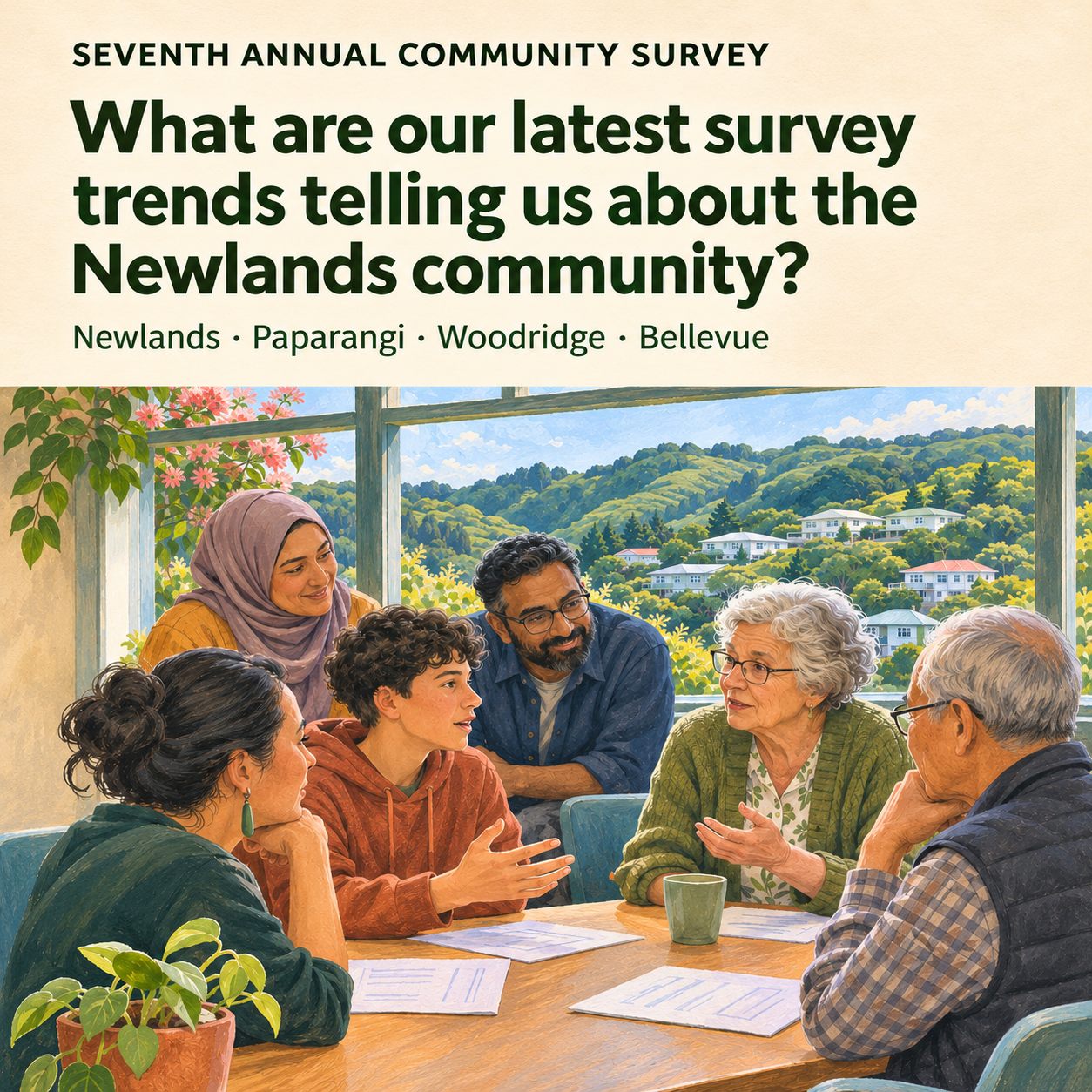
What are our latest survey trends telling us about the Newlands community?
What does it mean to feel satisfied with your job and still wonder whether you could find another one? Or to feel you belong in your neighbourhood and rarely take part in its cultural life? Our seventh annual survey across Newlands, Paparangi, Woodridge and Bellevue raises both questions.
Our projections to 2035 give us a starting point for tonight’s community conversation.
Economic resilience. Job satisfaction is trending upward to very high, while confidence in finding another job is edging downward within the moderate range.
Environmental resilience. Access to nature is trending upward within the very high range, confidence in how land is used is edging up within the moderate range, and confidence in water safety is holding steady at high.
Cultural resilience. Belonging is trending down to high, while cultural participation and cultural knowledge are trending downward to very low.
Social resilience. Life satisfaction and sense of purpose are trending upward to very high, while family wellbeing is declining within the high range and time spent volunteering is trending downward to moderate.
Disaster resilience. Household preparedness is trending downward to low, and participation in neighbourhood support groups is falling further within the very low range.
Governance resilience. Trust in the local council is edging upward within the moderate range, while trust in central government is trending downward to low.
Last week we heard from students at Newlands Intermediate and Newlands College. Tonight, 25 November, we’ll bring their perspectives into our conversation with residents. We’ll ask three questions. What might explain the trends? What can we do locally? What would we like Wellington’s decision-makers to consider?
At the Aotearoa Community Resilience Network (ACoRN), we call this community intelligence. It brings together survey trends, lived experience and local knowledge. Someone who has lived in a street for thirty years may remember why a neighbourhood group stopped meeting. Someone who moved in last month may have noticed how hard it is to find out whom to contact. Both have something to contribute to a conversation about preparedness.
In early December, we’ll publish what we learn to inform local action, conversations with Wellington decision-makers and our planned community resilience trial. My hope is that a resident reading it will recognise a point they raised and see who could act on it. Some decisions sit with neighbours themselves. Others sit with people who plan services, set priorities or decide how public money is spent.
For me, that is how this work can contribute to Wellington’s flourishing. It starts with understanding what matters to people in a particular place and giving them a say in the decisions that affect their everyday lives.
Explore our survey results and projections to 2035. Which finding would you most like a Wellington decision-maker to understand, and what would you tell them from your own experience?