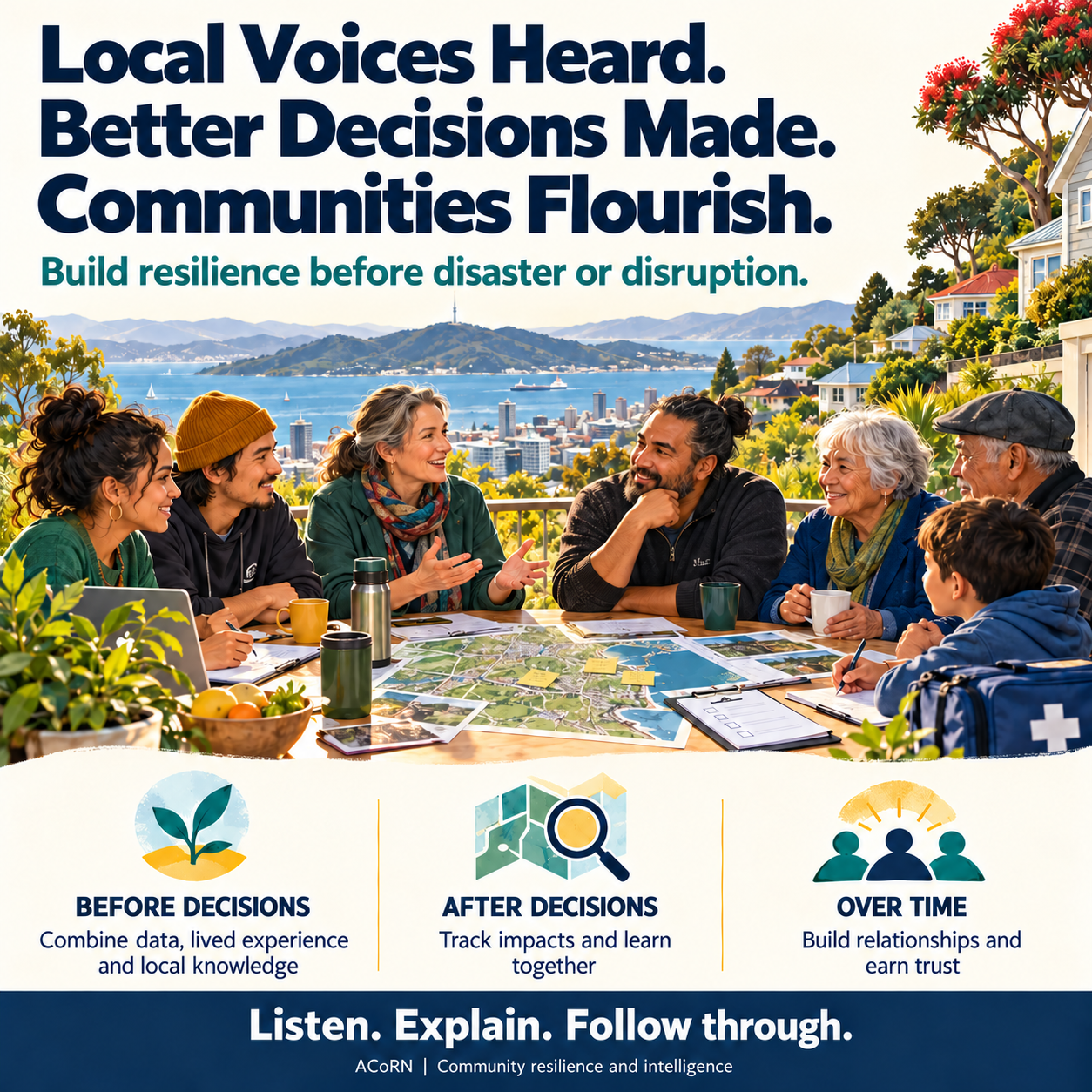
Local Voices Heard. Better Decisions Made. Communities Flourish.
How could community intelligence strengthen Public Value Decision-Making—and build trusting relationships between residents and decision-makers?
Since July, my posts have explored stronger communities, investment, Wellington’s flourishing and Community Connectors. Community intelligence connects these themes: data, lived experience and local knowledge informing action.
We need to build community resilience before a disaster and before a major decision that could affect residents. Relationships, mutual support, preparedness and meaningful participation take time to develop.
The preliminary Petone to Grenada Link Road analysis illustrates why. Construction could disrupt livelihoods, neighbourhood connections, wellbeing, access to nature and emergency preparedness. Afterwards, improved transport connections could strengthen regional resilience, while some environmental losses, social impacts and effects on trust could remain. These scenarios require further investigation and engagement.
Waka Kotahi brings a road transport perspective and can address effects within its responsibilities and project scope. Some impacts may remain after mitigation. Addressing wider community wellbeing also requires councils, other agencies, businesses and community organisations to consider their contributions.
ACoRN proposes connecting community knowledge with public decisions, and institutional support with neighbourhood action. Our Step Change proposal sets out this wider ambition.
November’s planned community conversation would bring together residents of Newlands, Paparangi, Woodridge and Bellevue, including young people and whānau. The 2019–2025 community survey results provide background to this conversation. Across six resilience areas, residents would explore why survey findings look as they do, what could improve, how to progress this and who needs to be involved.
Each discussion will identify what Community Connectors can progress and what we think decision-makers need to consider:
Economic: Life skills, employment, income and confidence finding work. Connectors could encourage budgeting and skills sharing; decision-makers could consider barriers to livelihoods and opportunities.
Environmental: Access to nature, water quality and land-use confidence. Connectors could encourage gardening and clean-ups; decision-makers could consider environmental protection, infrastructure effects and land-use choices.
Social: Personal and family wellbeing, independence, safety, inclusion, mutual support and participation. Connectors could encourage check-ins and shared activities; decision-makers could consider services, public spaces and work–life balance.
Cultural: Language, belonging, cultural participation and knowledge sharing. Connectors could encourage cultural exchanges and te reo learning; decision-makers could support cultural expression and access.
Governance: Trust in public institutions, participation and influence. Connectors could help residents understand responsibilities and contribute; decision-makers could explain choices, respond and follow through.
Disaster resilience: Household preparedness and neighbourhood support during the first seven days. Connectors could encourage emergency plans and mutual help; decision-makers could consider infrastructure, emergency access and coordination.
Over time, neighbourhood groups could combine data, lived experience and knowledge to complement government and council evidence before decisions, then help measure impacts afterwards. This exchange could build relationships and gradually strengthen trust through listening, explanation and follow-through.
Findings are planned for publication on 30 November, informing public decisions and the proposed March–May 2027 trial of 40 Community Connectors across 20 neighbourhood groups, subject to funding and readiness. Our investment brief outlines the opportunity to support this work.
The invitation is to invest in community capability before disruption comes. Residents contribute knowledge and local action; institutions listen, explain decisions and follow through. Together, these contributions could improve decisions, strengthen trust and help communities flourish.