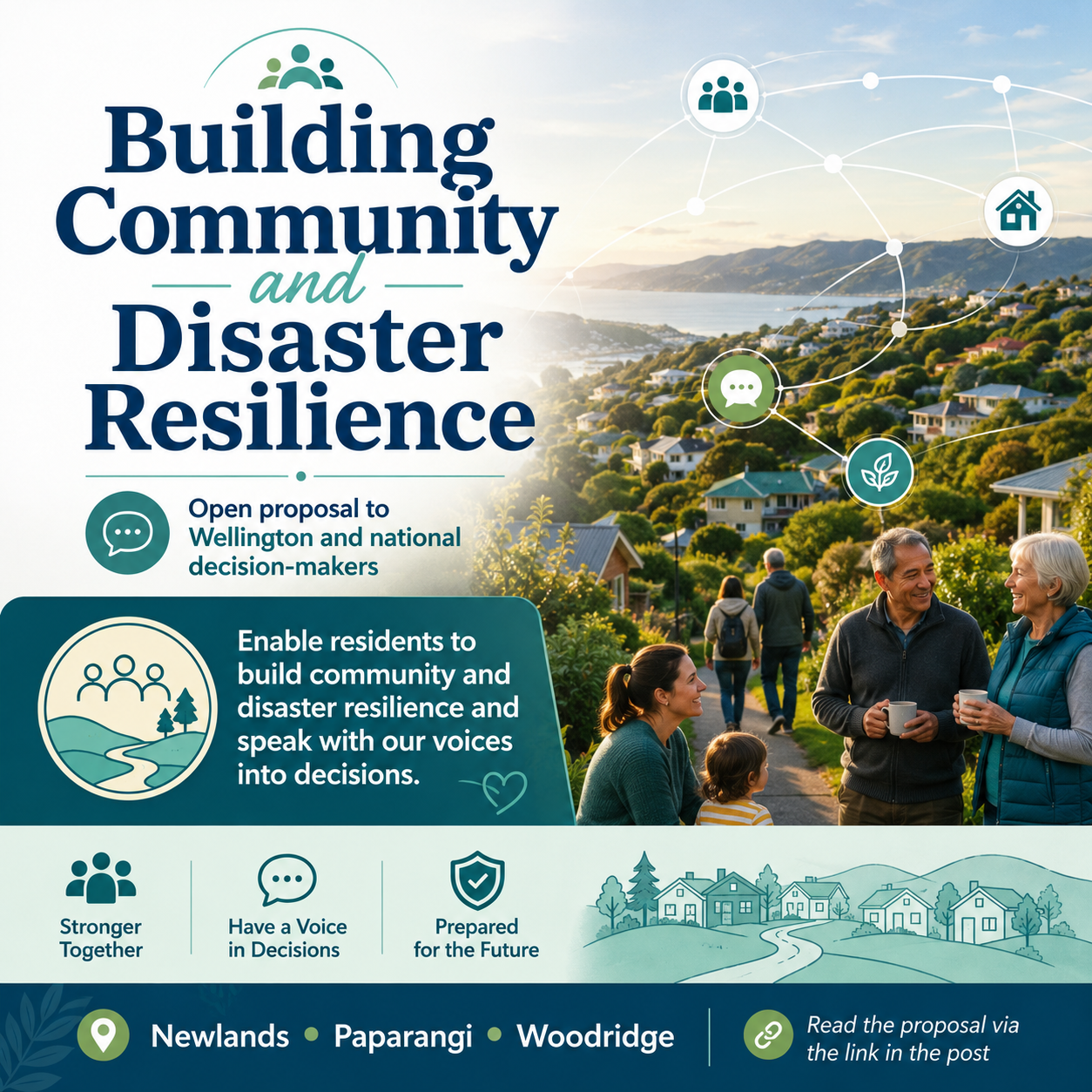
Building community and disaster resilience
The Newlands Resilience Group and the Aotearoa Community Resilience Network have released an open proposal for strengthening community wellbeing and disaster resilience across Newlands, Paparangi and Woodridge.
Its central proposition is simple:
Community resilience should not only be encouraged. It can be deliberately built as a practical and measurable community capability.
What our evidence shows
Since 2019, we have gathered community intelligence through six annual survey waves.
The results show significant strengths, including strong personal wellbeing, belonging and individual capabilities. They also identify vulnerabilities in household disaster preparedness, neighbourhood participation, volunteering and trust in public institutions.
This suggests that individual wellbeing does not automatically create collective resilience. A community may contain many capable individuals while still lacking the relationships, organisation and preparedness needed to respond together during a major emergency.
What we are proposing
We are seeking collaboration and co-investment in an 18-month community-led pilot.
The pilot would be implemented in three connected phases:
strengthening community connection, trust and participation;
improving household and neighbourhood disaster preparedness; and
enabling residents to speak constructively into decisions affecting their community.
The model would include Community Connectors, trained mentors, professional supervision, practical neighbourhood activities, supporting technology and ongoing measurement.
Around 470 people currently follow the initiative, 90 residents have registered their interest, and approximately 15 are beginning to form a core group to steward the next stage.
Why this matters
Wellington faces increasingly complex and interconnected emergencies.
Resilience cannot be created after a disaster begins. Relationships, trust, local leadership and neighbourhood organisation need to be developed beforehand.
Government agencies and emergency-management organisations play essential roles in providing leadership, information and coordination. Our proposal explores the complementary task of building practical capability within communities.
Public-value decision-making
The proposal also includes a preliminary assessment of the proposed Petone to Grenada Link Road.
We are not supporting or opposing the road at this stage, and the analysis does not claim to represent the views of all residents.
Instead, the project is used as a case study to demonstrate that major infrastructure decisions should consider more than transport performance, engineering feasibility and economic benefits.
They should also consider community wellbeing, environmental stewardship, disaster resilience, cultural values and public trust.
We intend to engage residents further through our October 2026 annual community survey and update the analysis to reflect the range of views received.
An invitation
We welcome discussion with residents, mana whenua, councils, government agencies, researchers, funders and community organisations.
Our aspiration is to help create communities that are:
stronger together, better prepared for the future, and more able to speak with their voices into decisions that affect their lives.